Sunday, May 23, 2021

Field Visits (Bahir Dar and Debre Markos) and School Options

I have not even tried to write a blog for well over a month. I am not sure what to say about this season, but it has felt like a time of much action with little reflection. It is true that this time of transition, which has involved Rebecca and I tag-teaming our Ethiopia Rep. assignment since February, and parenting in Arusha as the alternative has been difficult. I will say, we are at our best when we can work together at all things, but this time of 'divide and conquer' while not sustainable, is the best solution we have found until the kids finish school in June. 

As you know from previous entries, Rebecca spent several weeks in Addis in the month of April while I focused on parenting and working remotely when they were at school. Now, in May, I have been in Addis for several weeks while she is back in Arusha. While the removal of the burden of parenting here does allow more 'free time' in the evening, the workload during the day is quite exhausting and leaves little desire to sit in front of a screen and write. The Ethiopia assignment is a larger workload by several orders of magnitude over the Tanzania program responsibilities. I can spend an entire day doing nothing but answering emails, or for that matter, printing out reports and filing them in large binders for each project. 

Certain processes here feel more 'old-fashioned' compared to our work in Tanzania. Almost everything I do involves writing a letter (complete with reference number that is kept in a book) printing it out, signing it, stamping it, and then scanning it and sending it by email somewhere, then filing it in a binder. Processes that were done with a click of a button, like transferring money, now involve two or three such letters to bank, partner, and then follow up to make sure I receive similar documentation back which is also filed away electronically and in hard copy as well. I am not a 'details' person, so this kind of methodical record-keeping adds a lot of work to the day, and I am not always the best at completing every step perfectly.

Despite this, I can count, among our successes this month, my application, and successful completion of the process to get a work permit here. The collection of documentation required to complete this began in May of 2020, because getting original copies of transcripts, diplomas, background checks, etc., then having them notarized at the local, state, and even at the Dept. of State level during COVID took about 12 months. The process was delayed in February this year when I arrived in Addis on a tourist visa. I had to wait until I returned in May on a business visa to complete the process. The successful completion of the process is almost entirely attributable to our GSO (General Services Officer) Wondweson who made multiple trips to the labor office and immigration to move the process along. (We also had to create numerous official, stamped, documents and cover letters from the MCC Ethiopia office supporting my application.) But in the end, I did succeed in getting the work permit. (It has to be renewed every single year, but the renewal is less grueling from what I understand.) I am now in the process of getting a residence permit from immigration, but with a work permit, that process is more straightforward.

(If you found the last paragraph tedious to read, that was the intention.)

So now, as a freshly minted MCC Ethiopia Country Representative, I have the authority to sign letters and use the MCCE stamp! Fortunately, this process did not prevent me from doing some other things that were more interesting the past 2 weeks, the highlight of which was a one week trip to visit two partners in the country to the North West of Addis near the towns of Bahir Dar (by lake Tanna), and Debre Markos. 

We left a week ago on a Monday morning. Our company included me, Wondeweson our GSO who also acted as driver, Sisay, our departing Food Security Programs Manager, and Mesfin, our incoming FS Program Manger. The trip was intended to be an introduction and orientation for Mesfin and I to two of our partners who work near these towns. 

We left about 6am on Monday because the first stop, Bahir Dar, was about a 10 hour drive. Our plan was to go to the furthest point first, then work our way back to Debre Markos on the way back. The trip was quite spectacular in terms of scenery, among the more impressive geological features was the Nile River valley, an enormous canyon at least 20-50 miles across and thousands of feet deep. From the top of one side you can see the road for at least 100 kilometers. It was not extremely treacherous as the road was fairly good, but well trafficked by trucks carrying freight. 

We arrived in early evening in Bahir Dar and checked into our hotel. The next day we met Shimetta the director of our partner AEID (Afro-Ethiopia Integrated Development) who was to be our guide to several project sites. AEID does WASH (Water Sanitation and Hygiene) projects with us and is well equipped to do so as they own a portable drill that can drill to 100 meters, a medium length well, definitely preferable to the shallow 30-meter hand-dug wells that many communities must make do with. 

The need for clean fresh accessible water in the communities where they work is acute. Water sources can often be contaminated and women may travel 10 or more kilometers to get water. Ideally, an individual should have access to 25 liters per day, but a woman who must carry jugs 10 or more kilometers can barely manage 25 liters for a family of 5. AEID drills 6-10 well per year through a project we sponsor. 

We planned to visit several water points and at each site, we were able to see evidence of the appreciation from the community by the long lines of people bringing their 25-liter jugs to fill. At each point, we were invited by community leaders into one of their homes to share enjera with shiro (a chickpea sauce) along with local beer called t'ella, followed by a shot of local whiskey called 'areke'. 

I admit that what put me most out of my comfort zone was what I call 'asymmetrical risk tolerance' for exposure to COVID. The MCC and team and AEID team all wore masks at all times, but refusal to accept the hospitality of the community, involving sitting in a crowded 'hut' with others and removing a mask to eat and drink, would have been  perceived as a significant sleight and quite rude. I did not feel I could refuse, having chosen to come, but I did try to minimize the time in the homes. 

The second site we visited was particularly interesting because the drill was in operation putting in a 70-meter shallow well. It was fascinating to see it work. I was told that from start to finish a well is drilled and capped with a wellhead and cistern in less than one week. The community was out in force around the huge truck and we shared a big feast provided by a freshly slaughtered sheep right by the drill site. the community elder in this sub-village was an elderly woman who also welcomed us into her home for t'ella and areke. 

The third waterpoint, visited in the late afternoon, appeared inaccessible because of a washed-out bridge, (we are in the short rainy season). We decided to go the last 3 kilometers on foot and followed a flooded gully until we got to the community where the water point was. We arrived in time for a terrific thunderstorm and we once again took shelter in a small home which could have been a perfect setting for the creche of baby Jesus. Animals and people were all crowded into the home where we once again shared food and drink. While we did our best to maintain social distance I was uncomfortably close to a newborn calf who easily breathed onto my face as I sat against the wall. 

There was a break in the storm and we pretty much ran back a 'short-cut' (still 3 kms) over a small mountain back to the road where the car was. Despite high wind and lightning, we made it intact. We drove the 150 kms back to Bahir-Dar and arrived after dark. It was an exhausting but fascinating day. 

The next morning we got up early again and after breakfast and checking out of our hotel, we visited two more water points. Getting to them was, at this point, treacherous as the roads to the sub-villages were deep in mud and we had to go in a 4 wheel vehicle. Despite our best efforts we only made it to one of the two before we had to continue our journey to our next destination, the town of Debre Markos, about4 hours down the road. 

We arrived in Debre Markos in the afternoon and checked into another hotel. Debre Markos is not as charming as Bahir-Dar, which abuts a lake. In Debre Markos, our hotel was across the street from a large bus terminal which was quite loud, even from my third-floor vantage point. 

The next morning we headed to the office of our partner MSCFSO (too long to explain). They are, in short, a partner who specializes in improving food security through impressive watershed rehabilitation programs combined with training farmers in low-tillage 'conservation agriculture techniques to improve soil fertility and increased yield. We spent the morning seeing a 'before and 'after' slideshow which was staggering in scope. They improve land 1200 or more hectares at a time each year. The process involves working in large river valleys and building contour lines or soil bunds which prevent erosion. They manage grazing and put rock dams into enormous gulleys, some 30 or more feet deep which eat up the land. They plant trees on the bunds like certain species of acacia which can be used for charcoal as well as fodder for livestock. The transformation of the land, visible within even a year is impressive as one looks across a valley and sees shrub-covered bunds and tree-filled gulleys, especially in comparison to areas where they have not yet begun work. 

MSCFSO also does WASH projects in schools and communities in the same area and we visited several waterpoints. They also have been helping particularly vulnerable women in the communities where they work with income-generating projects to help them recover from loss of market access because of Covid.  We visited several women who had a dozen chickens as well as vermiculture compost which they use to generate income. 

We spent two days visiting projects of MSCFSO and it was one of the more impressive interventions I have seen. We ended our second day with a traditional coffee ceremony to welcome Mesfin and me, as well as a farewell to Sisay who has been working with them for the past 5 years. (Sisay accepted a position with MCC in Malawi which is the reason for his departure from the Ethiopia program.)

We had a good night's sleep then again left early in the morning for our return to Addis. We returned again by late afternoon. It was good to be back, probably not a moment too soon because there has been some ethnic violence in the region where we were around the upcoming election. When we arrived back in Addis, we heard that the road from Bahir Dar to Debre Markos had been closed due to violence that had blocked the highway. 

We returned on a Saturday, and I enjoyed having a weekend off. I went to the Lutheran church we have been attending and checked in with people we knew there. 

This brings me to a second very important mission I have been on, since my return in May. The fact is, we have a significant challenge as a family. We had hoped to put our kids in a nearby school that is affordable and uses the same Cambridge curriculum they have been using in Arusha. We received, however, somewhat devastating news that while Oren was accepted into 11th grade, David was waitlisted for grade 7 because of lack of space. 

This was very unexpected and very depressing for us. Both Rebecca and I need to work nearly full-time to keep this program running. There are few other options. The International school that is nearby is outrageously expensive at $40,000 for the first year. Other international schools would require a commute of more than 1 hour each way with no school bus option. So Rebecca or I would have to drive 4 hours per day to and from that school. 

After considering all options, we decided that homeschool until a place opens up is likely the least onerous. Fortunately, we found that Bingham school (where Oren is going) has a homeschool community connected to it in which kids can participate in extracurriculars at the school and even attend some classes. I was able to get in contact with some families who are connected with this group and even had a chance to visit a meeting of the group this past Saturday. It was encouraging to find a supportive community with many kids David's age. Despite our trepidation about homeschooling, it seems like this could be a sustainable short-term solution until space opens up at Bingham. 

I also visited several of the non-viable schools and found that they would have been reasonable second options if they weren't either extremely far away or too expensive. We are trusting God as we prepare for a short-term home school option for David  (maybe find a tutor?). It is good to know he can have a social life with this option though. 

In order to explore school options, I extended my stay an additional week so I will have been here for almost the entire month of May. I will return just before June, hopefully with my residence as well as my work permit. Our family will be returning to Addis for good on July 1. But before that, we have at least one more mountain to climb in Tanzania...more later. 

(For any Tolkien buffs, I was listening to Lord of the Rings during the long drives for the n-teenth time. I found it interesting that Bahir-Dar is a town just south of the region of Gondur in NW Ethiopia. I could not help but notice that Bahir-Dar sounds a lot like Barad-dûr home of Sauron, and Gondur sounds like Gondor, the land of Aragorn. Coincidence?)

Thursday, April 29, 2021

Openness

Rebecca with MK College guide
Henok and Solomon, my colleague

Rebecca writing this edition of the Ethiopia blog. I’ve been in Addis for almost three weeks and now I’m sitting in the departure lounge getting ready to head back to Tanzania for my final two months there. I’m grateful to Paul for insisting that I come and spend some time with the program here, solo, while he stayed back in Arusha with the kids. It’s been challenging for him to balance the heavy workload and the parenting. But meanwhile, I’ve had the chance to experience the rhythm of work and life here and to sense many possibilities for making this our home.

I arrived on a Sunday night and our wonderful General Services Officer Wondwesen picked me up from the airport and took me home. I was able to start the work week with the rest of my team Monday morning, getting accustomed to how we do things in the office here, with a tea break together, Monday staff meeting, time for office work, lunch prepared by our amazing cook Yeshi, and more hours at the desk. 

our shared desk in the office

In my first week, there were a few highlights, especially meeting the founder and director of one of our food security partners. I’m glad to know more about his original inspiration for starting Migbare Senay, and to understand how the organization has evolved beyond his original vision. A lot of the conversation needed to be conducted through translation, but there again my colleague and Program Manager Solomon was invaluable in being relational and curious on my behalf.

A lot of the work I needed to do on my stay here was in the financial realm since I will be overseeing financial reporting for our program. Our accountant and administrator Eyerusalem does all the real work, but I need to check it all and make sure it aligns with our budget. In addition, Ethiopia has very stringent requirements for documentation and compliance for NGOs. So, I needed to do a lot of composing official letters, stamping, copying, scanning, filing, etc.

Habesha food for staff lunch

Unfortunately, the COVID pandemic is amid another big surge in Addis, and while I was there, it was touching our team personally. One team member had just recovered, but the whole extended family then fell ill. Another team member lost an uncle who had been hospitalized. Everyone knew of church members or neighbors who had passed away in that week. People do appear to be taking precautions and wearing masks in public, but the virus still spreads. In addition, tensions are rising in many parts of the country ahead of the elections. Unfortunately, ethnicity is playing a role in sparking violence. Our housekeepers’ extended family had to flee their homes at one point last week, because armed militia of another ethnic group were coming through, killing people and burning houses. Many prayers are needed for the country to hold together through this election season and to not lose the ground they have gained as a nation, in terms of economic development and political standing on the continent.

Another major role I will take is overseeing our human resource processes. My initial task was to conduct annual performance appraisals with all the members of our program staff. I really enjoy having these times to meet one on one with colleagues and to learn more about their jobs and how they feel about their work. We managed to fit in all those meetings. Paul and I had our own performance appraisal with our bosses virtually, and I had to spend many hours in preparation, putting together my work plan for this new job. 

Welcome tea for Mesfin, with Wonde, Mesfin, 
Solomon, Yeshi and Yerusalem
In addition, over the past three days, I have been helping to orient our new Food Security Programs Manager. He started Monday and he will replace Sisay in working with our conservation agriculture partners. (Sisay is moving to another MCC program in Southern Africa.) We can immediately tell that Mesfin is a warm and experienced person, who will fit in very well with the team, along with having excellent practical experience with MCC partners under his belt. It has been stressful to deal with the transition of a key member of our team, just as we are starting our role. But we are grateful that we were able to recruit such an excellent candidate so quickly.

Donor meeting at the Hyatt

And speaking of Food Security, on my second day in the office, Sisay had helped to organize a high-level donor meeting at a downtown hotel. It was a good opportunity for me to go and meet other NGO leaders and support him. Our MCC partners have just finished a 5-year project funded by the Canadian government, teaching local communities about this kind of climate-smart agriculture that improves soil quality, rather than further depleting it. It was an incredible success, and along with the development work, research was done to document all these successes. The donor allocated funds to share these results as widely as possible, and thanks to strong advocacy by our partners, the Ministry of Agriculture has come on board to also adopt this method and spread it far and wide in Ethiopia. The main problem is that local partners need more donors to support them in scaling up this work. I found that most of the invited donors were not yet committed to supporting conservation agriculture though they were interested and asking lots of questions. Paul has been more focused on our CA work so far in the program, but thankfully I know enough about the work we’ve been supporting to speak up and encourage other donors to join us in this common effort. Getting to the meeting required me to take taxis, also a bit of an adventure, but my taxi driver back to the office also turned out to be a very engaging Amharic tutor.
One of my walking hills

Another aspect of my role will be to support our various young adult exchange candidates. We are hoping to send two or three young people to the US to serve for a year with the IVEP program. I took several hours each with two young women on my first week, helping them to fill out the very extensive application form for a US non-immigrant visa. A lot of online work is required these days for everyone, and these young women don’t have computers of their own. In addition, the form is not easy to understand and fill out correctly. So, along with that practical work, I was glad to have time to meet with each of these young people and get to know them before we send them off.

There was so much work to do that I found myself sitting at my desk most days until 5:30 pm. By 5:15 my newly adopted dogs started to get impatient, as if an alarm clock was going off in their heads. They would trot into the office and come nibble at my toes to get me to put away my computer. After sitting for so long, it felt very good to take time for a walk around my neighborhood. The streets are circuitous and a bit random, so I had some adventures, finding my way around new routes that would give me a good healthy walk for an hour or so. At almost 8000 ft, walking uphill definitely got my heart rate up! 

And then when I got home from walking, it was time to collect the day’s egg production. Sadly, the hens are not laying quite so many eggs these days: our suspicion is that they just don’t get as much variety to eat, since there aren’t so many humans living there, eating and creating vegetable peelings for extra chicken nutrition. I did enjoy taking the compost pot down to the hens: how often do you have the complete and full attention of 40 other living beings, tracking your every move? They couldn’t take their eyes off me until I tipped the pot over and let them go to town.

Chickens roosting in
the evening

And the dogs were always happy to keep me company in the evenings. Neither of them is big, and they really love to cuddle with humans on the couch. Bella is super cute but is a bit of a troublemaker, at just a year old. Once or twice, she stole food off the counter and broke a dish, and our housekeeper is not happy with her! We’ll need to lay down the law with her when we can catch her at her mischief. Friday, the older dog, has such a funny face. I always feel like I have somehow deeply wounded her and have broken her heart, with the way she looks at me, but that she is just going to patiently put up with my unjust treatment. Sigh.  I’m sure that’s not what’s going on inside her little head, but that’s what her expressions convey to me.
Friday gives me baleful looks

Yeshi cooks very good food for staff lunches, and there are always leftovers. So, I hardly had to cook a thing while I was there, and it was nice to heat something in the microwave and then watch an episode of the Crown (a show that interests no one else in my family). It was interesting to have so much quiet, alone time, with no need to care for anyone else’s needs. I have not had anything like this much extended introvert time for more than 18 years!

On my first weekend, I decided to get behind the wheel for the first time in Addis and drive to a nearby shopping mall. I wasn’t sleeping that well and it seemed a new pillow was in order, along with a few other groceries. And then I tried out the enormous 50m  pool located in the center of the mall. The changing rooms were deserted, thankfully – the riskiest part of taking a swim. There were a few kids playing around in the pool, so I had to stay alert to not crash into anyone, but it was very refreshing to enjoy a different kind of exercise, apart from the workout I was doing in my living room in the mornings before work. 

Matilda online, "We are revolting children"

Both Friday and Saturday evening, I got to watch a special show: the St. Constantine’s production of “Matilda.” David was in the cast as a doctor and a school kid, and they had been rehearsing the play since October. The actual production was postponed several times due to events in Tanzania, but finally they performed. I was sad to miss seeing it in person, but at least I could watch in on Zoom, right along with all of David’s grandparents (and a whole lot of other far-flung relatives of cast members). Unfortunately, the sound quality on Zoom was terrible, but we could still get a good sense of the energy and focus of the students, and especially the very clever and engaging dance numbers.

Sunday afternoon nap

There were many ways throughout my first week that I felt like God was lining up appointments for me to meet people at just the right times. Getting appointments with the IVEP candidates at the right times was one example. I’ve taken over the egg business from my predecessors, and that has put me in touch with a group of nearby missionaries who are very friendly and helpful. And that led me to a much-needed appointment with another missionary to get advice about visas for short-term volunteers. But the greatest gift came on Sunday. I decided to attend the church Paul had been scoping out (though there are other options)—it’s basically community-led and very open to participation, though it’s not a big community. I was really blessed to hear a great sermon from a Pentecostal Finnish guy who, it turns out, attended the same seminary in Canada that I did. The Anglican worship leader also encouraged us all to take a moment and to pray about why God had brought us there that morning and with whom he was calling us to have a conversation after the service. And so right after the service, I was greeting a man whom I know slightly through our work and he spontaneously invited me to join his family for lunch. I had been planning to go for a hike, but it felt like the prompting was to take up this invitation.

our gate in the evening

Sam and his wife Kathy were incredibly gracious hosts, together with their college-aged daughter. They had prepared a homemade Mediterranean feast, and also had invited an Egyptian-Canadian friend. I learned so much from sitting with all of them and hearing about the best places to hike, the best Italian restaurants in Addis, the political situation, Covid vaccine availability in Addis, etc. We also had many deeper, more philosophical things to talk about as a multi-culturally gathered group of Christians and it was a truly delightful afternoon for me. I also fit in an afternoon nap with the dogs that Sunday along with an extra-long walk around my neighborhood.

RPC office staff with Solomon & I on the right

Another work-related highlight was a field visit I took with Solomon and Wondwesen last week. We first stopped at the Addis Ababa head office of our partner “Remember the Poorest Community.” They are historically linked with the outreach ministry of one of the oldest Ethiopian Mennonite congregations. That previous generation really wanted to help children of very poor single mothers, and decided to open a preschool for orphans and vulnerable children. MCC has been a partner of that kindergarten for many years. In 2016, MCC started to support a nutrition program because teachers noted that children arrived to school hungry, with empty lunchboxes, unable to concentrate in class. The MCC school feeding program included balanced, nutritious, high-protein lunches and snacks five days a week. There was a marked improvement in children’s performance in school, attendance rates, and overall health. Kids who are well-nourished and attend three years of preschool school have a much better chance of succeeding – even excelling – when they enter free public primary school. Without that foundation, most of them fail in primary school and drop out, following in the footsteps of their impoverished parents.

Story-telling in the older preschool class

Sadly, that funding ended, and the program was cut, right when the COVID-19 pandemic started. At this point, MCC is only able to provide funding for tea and bread, 3 times a week. For some children, that small snack is the only reliable food they get because their family is so impoverished. Parents who were scraping by in the past through small businesses are finding it impossible to make ends meet in the time of COVID. The economic situation is extremely difficult for everyone currently.  The teaching staff are heartbroken to see their students sleepy and hungry, and they are using every possible means to try to make up the difference. They even committed to donating 3-5% of their very small salaries (they earn just $48 per month) to try to buy tea and bread for Tuesdays and Thursdays, but even that generosity does not meet the need for more than 2 more days a month. The staff of RPC made an earnest plea for MCC to find some way to help them restore part of the feeding program.
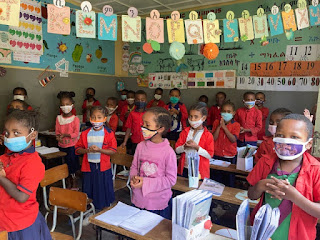
Younger preschool class "washing hands"
We went on to visit the school in Adama (Nazret), about an hour away. Two senior staff members introduced us to a few of the classrooms (we peered in through the open doors to reduce COVID exposure risk). The older children sang a few songs and recited things they had learned about body parts, letters, and other educational skills. One child entertained us with vigorous storytelling. Solomon tested the kids in fun, to see if they knew how to keep themselves safe from COVID. One four-year-old answered: “We wear our mask, we wash our hands, and  we eat our lunch!” Even young children had a very clear idea about sanitation, not touching their eyes or nose, and keeping their masks on (all the children seemed to have cloth masks to wear). We noted the energy and brightness that was evident among the students and the care of the teachers. The classrooms were all colorful and decorated with homemade posters – clearly a lot of effort has been made to develop an inviting and bright atmosphere in the school.

Principal Etgenet with the girls

Later we sat outside to talk with the school staff and a few parents. One parent, Mitiknesh Fekadu, spoke about how many of the children are street children, living in plastic houses. She asked why there is no feeding program. Her twin daughters performed at the top of their class this term.

Tilaya Hailemariam is a grandmother of twin boys. She is struggling to survive because the cost of living is so high, and with COVID, there is no opportunity for trade. Her daughter, the twins’ mother, is still around but has no work. Her two grandsons won 3rd and 4th place in class. Tigist is another committee member who raised the question of the school feeding. “It’s sad to see the kids have only bread – it isn’t enough.” Most of the children don’t have fathers but are raised by single mothers like herself. She struggles to even buy soap to wash her child’s clothing.

Twin boys with grandmother

The chair of the parents’ committee is an older man named Bahiru Jemal. He works closely in helping to choose beneficiaries for the school to make sure they choose kids whose parents could not afford to send their child to a private school. Only the poorest are enrolled, including many orphans who live with grandparents that really need help. The teachers are wonderful and it’s a model kindergarten, the best in Adama city, teaching kids to be creative and use local materials. Some parents send their kids long distances to come.

As a development worker, it is very convicting to hear these stories from community members. On the one hand, we recognize that these issues of poverty and hunger are not a problem with the school, but a structural problem in the community. The hunger needs to be dealt with on a broader level, because school feedings only treat the symptoms of the problem, are not sustainable, and don’t change the overall situation. Furthermore, education and school feeding are lower priorities for our organization right now, compared to bigger food security projects and interventions for displaced people. And yet, when one visits a school like this and hears the stories of how three years of a good preschool and good nutrition can make a difference in the life of individual kids who would have no chance otherwise – it’s hard to turn away and say no. This is one way to break the cycle of poverty for particular individuals. I was reminded of the story of a thousand stranded starfish. A man threw one back into the ocean. When asked, “Why bother?” he answered, “It made a difference to that one.” These are the very real dilemmas we are placed in when we work in contexts of poverty.

View from MK College in Debrezeit

In the afternoon, we visited the campus of the Meserete Kristos College, the institution where virtually all Mennonite pastors and leaders are trained. Our main purpose was to scout it out as a placement location for a potential short-term volunteer from the US. I was also very glad to meet the college president personally and to learn about their programs. It’s a very quiet, peaceful setting and the campus includes a working farm for income generation and feeding their students. I hope to be able to go back there for visits from time to time and stay in their guesthouse. There was the promise of some excellent birding…  

Entoto park view

On my second weekend in Addis, I took a longer drive to Entoto Park and spent most of the day walking from one end of the park to another, exploring and stretching my legs. Much of the time I was alone before I met up with another young couple out for a stroll or a family come to take photos and let their kids ride on the pedal carts. The eucalyptus forests are well preserved and thick, but it is not a natural forest, so not as much birdlife. Still, it was great to get out above the city and take a walk in a quieter environment. I walked more than 13 km up and down the hills in the park, with a cappuccino in there somewhere.

Apples forming on our trees

Early on in my solo visit, I had a chance to meet online with my spiritual director. We talked more about the passage I had been thinking about all during Lent from John 10: unless a grain of wheat falls into the ground and dies, it cannot bear fruit; but if it dies, it bears much fruit. I heard this as an invitation to hold loosely both the things I love in this world and the things I fear – not to cling to that which I love, and not to flee from that which I fear. Jane encouraged me to think even more deeply about the experience of the grain of wheat. It was once part of a stalk of many grains, a community, growing together, stored together. Suddenly it finds itself all alone, in cold, dark, unfamiliar ground. And at that point, the seed has a choice: to remain hardened, closed, grieving, refusing the instinct of life… or to open itself to totally new possibilities, the feel of the living water inviting it to put down roots, the sense of the warmth of the sun, yet unseen, above it, calling for a shoot to come out. Being open to change and growth is hard; it requires one to be split open, left vulnerable. It can be tempting to stay closed, to cling to the old, as the only way to honor the very real grief that we feel when life throws us a curveball. And yet openness is the only choice that leads to abundant life. I do give thanks to the Spirit at work in me, helping me to set aside more of my unholy grumpiness, my fleshly desire to close in, and to be open to more of the possibilities going forward. It’s been a good three weeks to practice that openness and to feel the growth that comes as a result. 
Coffee blossoms in our yard


Friday, March 19, 2021

COVID Delays and Other News


I have been vacillating between calling this update "A Middling 3 Weeks" and "A Covid Journey". I am writing on the eve of my much-anticipated departure from Addis to join my family back in Arusha for at least 3 weeks all together (before Rebecca comes to Addis for a few weeks in April). 

Rebecca gave an update on the family in the Tanzania blog a couple days ago, but I have been remiss in adding much on this end, because frankly, since their departure and return to Arusha, life here has been quite routine. I have needed to be in the office, which since it is located in our compound, does not even require me to open the front gate. (Hence, very few pictures in this update.)

Among the projects we are focused on, finding a way to respond to the Tigray crisis in Northern Ethiopia is one of our high priorities. The Ethiopia Mennonite Church (MKC) actually has about a dozen congregations in the region, and also has a fairly high capacity relief and development department that has submitted a proposal to distribute much-needed food aid to communities in which they are located.

I had a chance to discuss this with pastors and church leaders from the region who were in Addis for a trauma healing workshop. They described extensive property damage from burning and looting, a breakdown of civil order in areas that have been abandoned by the Tigray Party (TPLF) but not under Govt. control either. Many have fled, there is no electricity, medical supplies, and acute shortage of food as well as means to buy anything. 

We are hoping to do a procurement of teff (grain for injera bread) as well as blankets through MKC to support about 700 of the most vulnerable people in two of the cities that have not been effectively reached by other aid organizations.  

This is a good point to break off and talk a little bit about COVID and weighing risk and urgency in terms of deciding what I can and can't do of my job here. The positivity rate has been steadily climbing in Addis since my arrival. It was at about 8% when I got here and this week it was up to 25% on several days last week. That is alarmingly high. I avoid going out a lot, but I have gone shopping for groceries, and occasionally gone to the large (50 meter) outdoor pool in Laphto Mall to swim. I always wear a mask, and in fact, we only allow 4 people to work in our offices at a time and we wear masks, even though we are in separate rooms, the whole day when we are in there. 

But the visit to discuss the Tigray with pastors put me in a situation where many people coming from rural areas were not fully compliant with COVID protocol, and the meeting was not something that I was in charge of. In order to be there I had to weigh the importance of the discussion, and my own risk tolerance when I was one of the few wearing a mask. (I do now have a way of stapling a surgical mask to it fits like an n95, something I have had to learn as I find more and more COVID fatigue and non-compliance as the duration of this plague continues to extend.) Gone are the days for me when I will ever wear a cloth mask assuming that I will protect you while you protect me. 

All that to say, I felt the meeting was worth the risk. To hear firsthand, reports from Tigray to be able to communicate back to our constituents seems very important now. This is a major crisis that actually threatens to destabilize the country. There is a power struggle that falls on old ethnic fault lines, but also involves some opportunistic revenge killings by Eritrean forces who have had a longstanding hostile relationship with the TPLF. In the news, you may have heard of a number of reported atrocities and stories of ethnic cleansing. From what I am hearing, the situation is complex and involves historic animous and concern about legitimate provocation from the TPLF who would like to be back in political power nationally. 

Besides that meeting, however, I have not been among large groups of people very often, preferring to keep to myself. The exception is church which has strict COVID protocols. The past two Saturdays I have gone back up to the Entoto Mountain Park which is a great place to walk a 10k (or run if one was so inclined) It offers a very long steep descent which you then have to ascend again, the 10,000ft altitude provides a workout for the lungs as well. 

I have been swimming about twice per week. From Arusha, in the cold season, I have become acclimatized to very cold water, and I would say that the pool water here is at the lowest point in that season. I try to swim 2 kilometers, which takes just under an hour, but on a few occasions, I was not able to stay in the water that long, even swimming furiously. You can just feel your body temp. dropping each minute. Even getting out requires a kind of slow rewarming to get back to normal. Still, I do have a bit of an addiction to a very cold water swim. 

The other big work event has been a process of hiring a new staff member. Sisay, our food security program manager will be taking a position with MCC Malawi and we are in the process of replacing him. Because of a quick turnaround time, we have been doing this as expeditiously as possible. I was supposed to be here until last Wednesday but realized I needed to stay until at least Monday to be here to finish all the interviews we wanted to do (a huge sacrifice because our family has been really strained from 8 weeks of me being away). It was an interesting setup interviews with Rebecca and Sarah, our regional HR manager, in Arusha and Kigali respectively, then Solomon, our program officer, and me in Addis live, with the candidate. It worked quite well and we set up a good socially distant room arrangement to make it possible. We finished on Tuesday just on time for my rescheduled flight on Wednesday.

I know air travel is discouraged in the US for good reason. Internationally countries do allow travel but require a negative COVID test within 48-72 hours of flying in order to board. I don't know how often readers of this blog go in for COVID tests, but I am guessing if you are not a health professional, it is not too often. The PCR test, the one we get, as most know involves a fairly unpleasant swab jab deep into the nasal sinus cavity. One of the most annoying feeling procedures I have endured. But it is nearly masochistic to endure it as often as we have in order to travel for work. I feel like I get one about once per month. 

For travel, one does not expect to get a positive result if one is asymptomatic, and the biggest shock of this past Tuesday was a call from the clinic where I went to tell me I had received a positive result. I was frankly stunned, devastated, and very anxious simultaneously. Stunned--because I just did not believe it was possible for a person of my age to have it and be completely asymptomatic and feel, frankly, fantastic. Devastated-- because there was no way I had time to get another test that would allow me to travel the next morning. Anxious--because if it was accurate, then I was probably pre-symptomatic had the prospect of becoming seriously ill, alone and away from family in Addis. 

I spent the next 2 days assuming that every time I cleared my throat it was an indication that I did indeed have COVID. (Note: I did not give up my brutal 30minute HIIT routine every morning!) Finally, on Thursday I went back because I just did not believe it was possible that I had it. I got the result that night-- negative, and quickly booked a flight for Saturday, which at the writing of this blog is tomorrow. I am counting the extra week of being here as a trial, and an opportunity to feel grateful for the chance to go back to be with my family. I hope I can be a more patient parent after enduring all of that.


I will say by way of prologue that I did not waste time around the compound doing nothing. One of the more rewarding tasks was doing some rearranging of furniture in the house to make it more our place. After all we inherited fully furnished from the previous reps. I have put up a few photos showing my efforts. I have expanded the living room out and moved another table into the dining room. Interestingly, it looks a lot like Charter Hall now, the place we spent a lot of 2020 in lockdown. It was a very peaceful place, so perhaps the resemblance is not a coincidence. 

Tomorrow I fly out to spend about 6 weeks in Arusha before returning here. I will update on the Tanzania blog. 


Monday, March 1, 2021

Rep Sendoff and a Field Visit to Ziway


Once again, time slips by without an update and I look back on the jam-packed last two and a half weeks and feel daunted by the prospect of documenting them. There are a number of highlights that I will capture here. 

As mentioned in the last entry, we have been (and now completed), our Rep transition to Ethiopia. That is not to say that the whole family has moved here, but the steps in taking the reigns of the Ethiopian program is now complete. It started with me alone coming for three weeks but was then joined by Rebecca and the boys for the last week of transition with Bruce and Rose. 

To say those days were filled seems a bit of an understatement. When the family arrived on a Thursday night I moved out of the container guest room I was staying in at the MCC compound and moved up to a nearby guesthouse with the family. It had a very commanding view of the city from its roof.

The next morning we headed to the MCC compound and Rebecca spent the day with our accountant Yerusalem and Bruce learning about the financial system here. I should mention as well that Wawa, the MCC Area Representative was visiting as well, so all of us were involved in orienting Rebecca and Wawa to the context here. 

David had a great time playing with his new pet dogs, Friday and Bella, and tending chickens and collecting eggs. He was really ready to move in fully. 

Wawa was also here to debrief with Bruce and Rose as they completed their assignment, as well as participate in festivities around their departure. The most elaborate one was an all-partner gathering at a hotel to which a representative from all MCC partners was invited. It was both an opportunity to say goodbye to Bruce and Rose, and to welcome Rebecca and I. Wawa played the role of master of ceremonies for the event. 

Prior to any departure activities, however, we had an out-of-town field visit which also allowed the family and Wawa to get a taste of the countryside outside of Addis. We departed for Ziway, a small town on a lake to the South of Addis. We left on a Sunday right after church. It was good to be able to go to the International Lutheran Church as a family since this is almost certainly where we make a church home here in Addis. Although smaller, it is not unlike our church in Arusha. Both Oren and David were able to connect with some potential new friends their age during the fellowship time right after the service. 

We returned to the MCC compound and Wawa, and my family got on a mini-bus rented for the purpose of taking us to Ziway along with Solomon our Peace and Education Coordinator (and translator during this visit as well). The trip took about 5 hours including a stop for lunch at a nice little restaurant next to a strawberry field. One of the features was a strawberry smoothie--made entirely of blended strawberries. 

We arrived in Ziway at the hotel where we were staying, which was right next to the lake (Haile Resort). We were a bit worried about how crowded the place would be as there was a large wedding celebration going on there during our arrival. Fortunately, they were not overnight guests and it settled down by evening. We were COVID wary the whole time and chose to wear masks indoors and did all of our dining on a patio next to the restaurant. The food was good and accommodations comfortable. Sadly the lakefront right by the hotel was completely overrun with water hyacinth which made fishing or even seeing the water impossible. 

Rebecca and I took a short walk down the shore to a kind of pier to explore the possibility of fishing elsewhere as David had his heart set on it. From the pier, we had a great view of a variety of species of birds (although maribou storks were by far the most common). We were also surprised by a hippopotamus that swam by the pier--not an animal I was expecting to see here.

On day two, we had a plan for a full day of field visits to one of our church partners (BCDA--under the Beza church), who was doing a school WASH project at 3 primary schools in the town. Among the most important contributions they were making was the construction of an improved latrine system at each school along with shallow wells to give access to water for handwashing and drinking. To understand the need for such an intervention, imagine a school of 1500 students served by two rudimentary pits dug into the ground, protected by a doorless shack. the problem of open defecation on the school grounds, a serious health hazard, was understandable. The intervention also provided girls with washable, reusable sanitary napkins, a provision that greatly reduces absence rates among girls. 

We left in the morning and met Gemedi, the project manager, at his office and traveled with him to visit 2 of the 3 schools. At the first one, we were able to meet the 'sanitation committee' which included school officials as well as parents who talked quite a bit about the need for this. We also met a student hygiene club and heard them talk about their work at improving sanitation on school grounds. I was very grateful to have Solomon along as a translator so we could understand what was being said. 

At the second school, we met with school staff and were given a tour of the current sanitation facilities. There were two stalls for the entire student body. The water source was nowhere near the facilities so handwashing was not possible after using the toilet. It was again a reminder of what we can take for granted coming from a North American context. 

We returned in the afternoon and Solomon arranged a boat trip for our family. It was enjoyable going out on the lake. David and I both tried fishing off the boat but had no luck despite the fact we were told there were a lot of catfish. We did circle a small island aptly named 'bird island' which seemed to be a nesting site for numerous species of waterfowl including, spoonbills, pelicans, cormorants, and herons. 

David and I tried fishing off the shore once we returned but sadly never caught a fish. Our family enjoyed playing cards before dinner, and read stories before bed. 

The next morning we did a second series of field visits, this time to a project run by the MKC, the Ethiopia Mennonite Church. It was a women's empowerment project and was focused at helping very marginalized, vulnerable, women and girls learn entrepreneurship skills and start a small business. The beneficiaries targeted in this project were women who had been forced into lives as sex workers because of poverty and had contracted HIV/AIDS. Although they had access to ARVs through the govt., they desperately needed an opportunity to get out of the sex trade. 

The project has been extremely successful and we were able to stop and visit 5 women at their place of business. It was quite impressive to see women as young as 18 running a business. And to hear their testimonials was heartwarming. It was clear that they were grateful but also committed to the opportunity for a new start. 

Rebecca wrote up a trip report with details about the work of each of these women, I took photos. Here is the story:

Itsubi Wondwesen stands with a shy but dignified smile under the shade of her own small business. She’s only 18 years old, but already she runs a small hair salon inside a one-room shop and also sells plastic wares right outside. The Ethiopian Mennonite Church Relief and Development Association (MKC-RDA) in Batu region became aware of her as an orphan, living with HIV/AIDS and in need of assistance. She joined one of the self-help groups run by the church committee and over the course of a year, learned about how to be a hairdresser and how to run a small business. She is healthy, receiving free ARV therapy from a government program, and also continues to attend 10th grade three days a week (schools are running on shifts during this COVID period). She says that she makes 300 to 400 (USD$ 7-10) birr a day in income and is able to save 50 Birr a day as a contribution to the traditional savings group she’s part of.

The businesswoman next to her, Dirb Buksa, is also a member of a women’s savings group, supported by MKC-RDA, although not the same one. She laughingly says, “No, I’m part of a senior’s group. Itsubi is just a teenager and she has her own group.” Still, Dirb has encouraged Itsubi along the way, helping her to realize that she could diversify her business by selling plastics along with doing hairstyling. Dirb herself was a commercial sex worker in the past but hated her past life. “I was living between life and death,” she says. Her group members assisted her to come out of this profession and start a new way of life. She started a very small business selling groceries and has gradually built up her business; now piles of red onions and tomatoes stand outside her small shop, and snack bags of roasted barley hang in the windows. Along the way, she accepted Jesus as her Savior and now has a joyful outlook on life. Both she and Itsubi each pay 1100 Birr per month to rent their shops, and they are able to afford a much better life for themselves.s The older woman even watches Itsubi’s shop three days a week while she attends school.

MKC-RDA uses an existing traditional structure to bring women together to talk about important issues in their lives. Normally, people sit together for the traditional coffee ceremony. Over the three rounds of coffee service, people would typically use the time for gossip and back-biting. But the community organizers in Batu have used that time as an opportunity to discuss good business practices, gender-based violence, and ways to escape commercial sex work.

Just around the corner down the cobblestone street, donkey carts passed by carrying water, and we walked over to speak with Esther, 35, the owner of a small restaurant selling injera, pasta, and fasting food. Esther could not stop thanking Endale, the project coordinator, for the MKC-RDA project. About 10 years ago, he invited her to be part of a self-help group, and that’s how she was able to get tested for HIV and to learn her positive status. Thanks to Endale, she was able to start ARV treatment and gave birth to a healthy child. She stopped selling local beer and started selling kolo (roasted barley), but Endale encouraged her to think bigger because she was so industrious, and so she got business training and now runs her own restaurant. She became very emotional as she considered the change in her life. “It’s not about the money; it’s the counseling. Many of my friends have died, but I am alive, healthy and living a blessed life. Without this guy, I would be dead by now.”

Across the street, Hiko sells clothing and fuel-efficient stoves for making injera, the traditional Ethiopia pancake-like staple. She also used to be a commercial sex worker, smoking, drinking and using chat. She’s 47, but she admitted that she probably looks older than she should because of the hard life she lived in the past. Now she has a totally changed life. The counseling and teaching she has received as part of the savings group has really helped her. Now she can afford to eat three meals a day, instead of just one, and to send her two girls to school. Her sister gave her a space outside their family home to set up a plastic shelter and run her business. The impact of the work of MKC-RDA also brought tears to her eyes: “I have been brought out of darkness into light. Now I am a dignified woman.”

MKC-RDA also sponsors health education programs in local secondary schools. We were able to briefly step into a half-day roundtable discussion on Gender-based violence and forced early marriages in the time of COVID. About 50 young women and men gathered in a large room (socially distanced and masked) to learn more about GBV and how to stop it. The months of lockdown and school closures have been especially difficult for young women who found themselves facing rape, abuse, and early marriage away from the protected space of the school. MKC-RDA partners with school staff and government officials to foster good discussions about these issues.

We stopped by another hair salon, run by three young ladies, Afomia (19), Samira (18), and their friend Madinit. They grew up in the Batu area and got connected with another local NGO (Africa Service Committee), which provides HIV/AIDS testing, counseling, treatment, and vocational training. They all took a year of training in hairstyling, and also have been working with ASC to raise awareness in the community as part of a dance troupe to spread health messages. MKC-RDA often partners with other local NGOs like ASC, and so they were able to provide start-up capital to the young women to begin their salon. They have only been in business for about a year and have had to pay off investments in their salon equipment, but they should be able to start saving in the coming months.

MKC-RDA Batu has just two paid staff, Endale, and his assistant. Most of the work is run by volunteers from the local Mennonite Church, who see it as a mission to their community to meet with groups of needy women, encourage them, counsel them, and offer them training. The board chair of the project, Getu, is himself a Medical officer. He runs a clinic to offer free or low-cost medical care to low-income women, including family planning services, prenatal care, and routine treatment of common diseases such as malaria and respiratory infections. In addition, he volunteers his time as the Chair of the MKC regional board. The local church even supports the project with free office space, along with the time, energy, and love of church members who join Endale to come alongside women living with HIV and who need help to seek out a healthy lifestyle. As we kept hearing over and over, it’s not the money that has made the difference. It is the counseling and the care of group members who have assisted women to change their lives. 

After these field visits, we left Ziway and headed back to Addis with another lunch stop along the way. Coming back was significant because, while we were gone, Bruce and Rose had moved out of the house to the guest house we had stayed in so we could have a few days as a family in our new home. It was a very kind gesture as they were only days away from departing. Although unfortunately, their departure date was up in the air due to a positive COVID test, which two days later was negative again, allowing them to travel. 

The last goodbye event for Bruce and Rose was a lovely gathering at the MCC compound of all the staff, (4 office staff, 4 guards, and cook) along with Wawa and our family. We had a fabulous Ethiopian feast outdoors followed by a goodbye ceremony in which many gifts were given and heartfelt words were spoken. It was a fitting final ceremony before their departure. 

They left the next day, followed by Wawa hours later, which left my family, alone for the weekend in Addis before they were to depart on Sunday morning. Given the short amount of time we had, we did our best to make the most of what Addis had to offer. We tried out the Coldstone creamery not far from our house and visited the mall. On Saturday we went to a place called Entoto Mountain Park which is very new and completely awesome. It is in the mountains on the outskirts of town and features long hiking trails along with attractions like zip lines, trampolines, go-carts, restaurants, coffee shops, and more. We walked about 3 kms away from the car, stopped at the trampoline house when it started to pour. We ended up running in the rain back to the car (with one stop at a coffee shop.) It was cold because the altitude on the mountain was about 10,000 feet, but we survived. 

We stopped for pizza on the way home, and despite the rain, we had a good time and were happy to know about the place.

I took the family to the airport last Sunday morning without difficulty. After they left I went to church. 

The last week had felt lonely as I am here alone for several more weeks. The one highlight was this past weekend when I attended a retreat for the church we are joining here. It was at a lake called Lake Babogaya. It was an amazing place- a retreat center lakeside owned by a mission. It has a great dock where you can swim or fish, kayak or canoe--no water hyacinth either. I can't wait for David to get back here to see it.