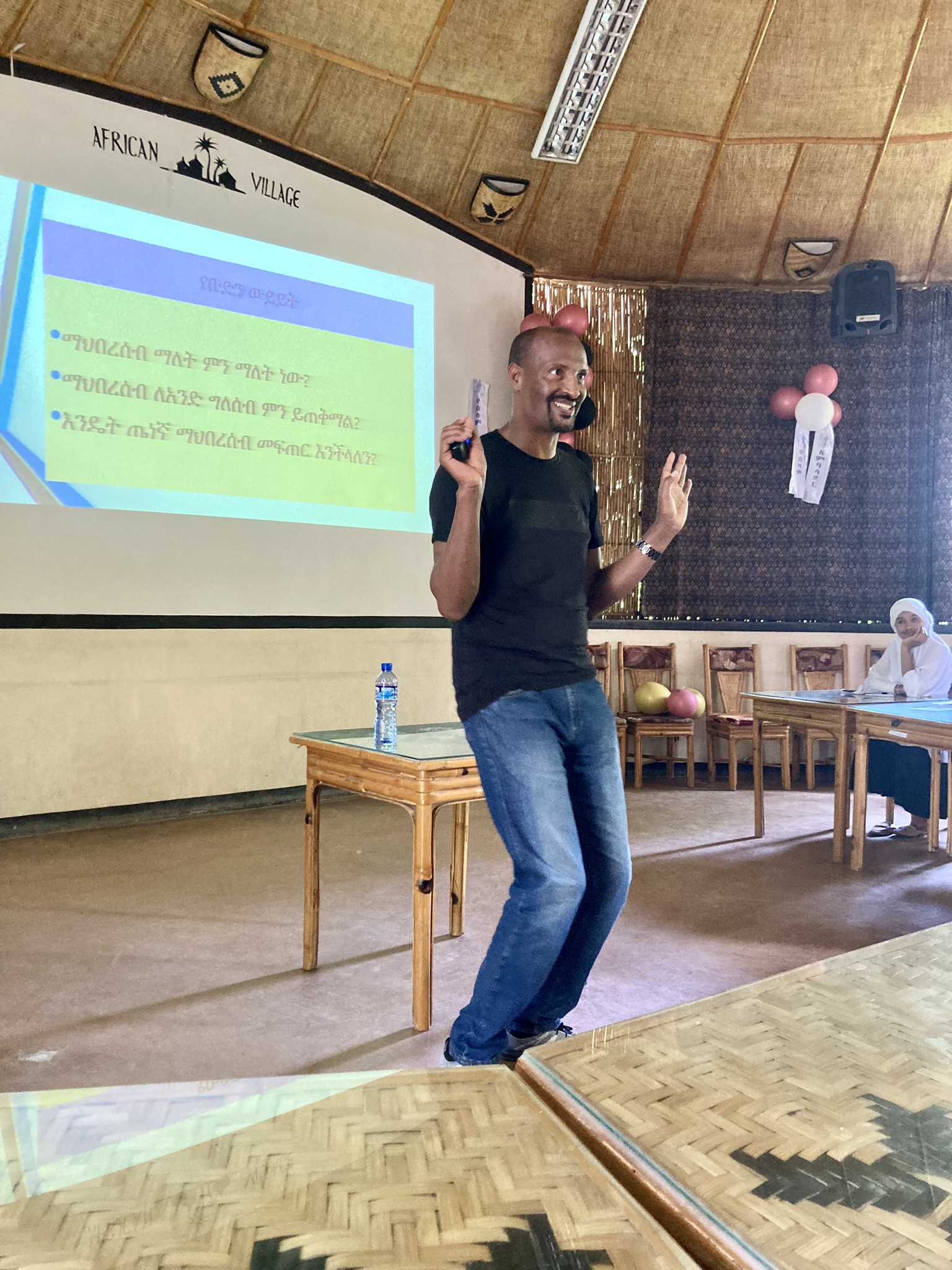
LLT on Orientation Day
These past two weeks, we have been hosting a Leadership
Learning Tour and taking them all around the country. It’s Wednesday night, May
31, and I need to get our second May blog mounted tonight. The LLT will
officially end on Friday, so we’re not quite at the end of this two-week
hosting extravaganza, but this is a good moment to offer up a very long account
of the partner visits and learnings we have had along the way. Rebecca writing
for now, and hopefully, Paul will add details in the next blog.

Orientation Day
Sunday, May 21: We officially welcomed the learning tour
team on Sunday evening for dinner at the hotel cultural restaurant Mesob. It
was interesting to realize that most of the participants did not know each
other any better than we knew them. We enjoyed a good evening together, mostly
over traditional Ethiopian food, starting to build relationships. People were
quite surprised and pleased by the hotel we found for them. Honestly, that was
an amazing coup for us – Wonde supplied us with a connection, the hotel made an
offer, we responded with our actual budget per night, and they thought about it
and agreed to give us standard single rooms for $35/night. The rooms were
really nice, and there is a pool, a gym, nice grounds, three restaurants, and a
pleasant common space. Oh, and quite a nice board room for our meetings at either
end of the trip.
Preschool welcoming committee
Monday, May 22: We started our two weeks together with a
full day of orientation. In total the whole team included 12 Learning Tour
participants (many board members from different MCC regions, a few donor
relations and other staff), our International Programs Director Rebecca, Our Area
Directors Wawa & Kristen, The Southern Africa Area director Pugeni, the DRC
Rep Jacob and ourselves. Our very first activity was delegated to Paul, to lead
us all in a folk dance, which people really enjoyed. Then the MKC President
Desalegn led us in a devotional, exploring ethnic diversity, conflict, and the
church. He made some interesting observations about Acts 6 – that the ethnic
conflict between Hellenistic Jews and Hebrews occurred in a moment of church
growth and change. Then we moved into more practical considerations of the
Learning Tour, logistics, presentations of our Programs, etc.


RPC parents in Self Help Groups
It was a good
day, but also involved a lot of hosting attention to detail. By the time we got
home, we were tired – but we still needed to pack and make sure everything was
arranged for David to figure out how to carry on with life with no parents
present (specifically, would he eat and get himself to the school taxi?).
Thankfully, Oren’s friend Bereket (18) agreed to stay with him, and they get
along well. Barry is also a very responsible and resourceful guy.
Tuesday, May 23, RPC Preschool:
It’s really hard to lead a learning tour and leave the house
on time at the same time! We were just about ready with suitcases, etc, and still
there are questions: has anyone fed the dogs? We did manage to get to the hotel
to pick up our guests pretty much when scheduled. We drove to the nearby city
of Adama to start our partner visits with Remember the Poorest Community
Preschool. We were greeted by a little choir of 30 kids, singing their welcomes
in English and Amharic, sharing their smiles and beautiful faces.
One major challenge for this project is that children are
selected from extremely vulnerable families – orphans, and single parents, without
regular income. MCC used to support a school feeding program but had to cut
that because of funding issues. Now many children do not have resources for
lunch, or they come with a lunch box that is empty. It’s been heart-breaking for
their teachers. Currently a simple snack of tea and bread is provided, but it’s
not enough. Yet hunger at school is a community problem, not just a school problem.
MCC is now supporting RPC in a new approach, forming the parents of these
preschoolers into self-help groups (SHGs). These groups meet weekly to save a
little money, support each other and then give each other loans for small
businesses. RPC has worked with many other groups of vulnerable people and seen
huge changes in their livelihoods over time, so we are hopeful that the parents
of these children might soon have enough to provide lunch.
Preschool snack program

Parents SHG
We had a good time splitting up and talking with three
different new groups, just six months old. The Andenet (Unity) group are all drawn from
the same neighborhood. In the past, they never even noticed each other or
greeted; now they are close friends and support to one another. They have saved
about $500 USD so far, and given out loans to each other for projects like
selling used clothing, making injera, and buying a scale for selling vegetables.
The group includes two men, and one of them talked about the purpose of the
group: “We are not just meeting for our personal development, for making money.
But we are meeting because our country has no peace. When we meet, we establish
our stability, our peace.” Social cohesion was not an explicit project outcome,
but it is affirming to hear that peacebuilding is naturally emerging out of
this new project approach.

We split up and visited different classrooms, listening to poetry and song in English, Amharic and Oromo. Those kids are absolutely the cutest ever, and their smiles are real. They are really getting a head start in education that can carry them into a better place in life. The teaching staff at the school remains incredibly dedicated, in spite of the challenges and low salary, with almost not staff turn-over. They remain creative and engaging and the children know that they are capable.
We finished our visit by RPC treating our LLT guests to
their first official Ethiopian coffee ceremony. The whole process of roasting
green coffee, pounding it and boiling it in the jebena – it was all going on
through out our visit to the classrooms. And then we sat and talked more about
the project and it’s challenges. It would be great to offer more long-term
follow up of these young students, to support them as they move into primary
and secondary school – but it’s hard to know how to do that. And the demand for
such good preschool education is very high. We wish we could support dozens of
schools like this.

Batu Lakeside
After leaving the preschool, we had lunch and then drove
on further south to the town of Batu/Ziway. We got there in good time and had
opportunity to rest and walk. I joined a few other folks, exploring the new
paved walkway right along the lake. It was a wonderful addition to the town,
with lots of waterbirds along the way, and many locals walking and relaxing in
the green space. Hopefully tourism will start to return at some point, if the
situation remains stable. I even had time to jump in the pool and swim a few
laps before dinner – very refreshing on a warm night.
Wednesday, May 24:
MKC-DC MCH project: We have two partners working in Batu/Ziway
and so we started the day meeting at the MKC Church in town. During the HIV/AIDS
crisis, this congregation became aware of the needs of many vulnerable women who
were commercial sex workers out of financial necessity, and needed health care
support. The church started working to help these women find other ways to earn
a living, through self-help groups and income-generating associations.
Overtime, this congregation-supported project has become a real development
project focused on maternal and child health. Now women are part of care groups
and receive weekly training in various aspects of public health. Income
generation and savings remain an aspect of the project. 
Kids play, mothers talk

Mothers' group
We sat and watched as one group of women met under the
trees in the church year. Many of the women in this group were ethnic Somalis
from eastern Ethiopia, displaced from home by a conflict a number of years
back. All the women came with their babies and little children. We had some
time to freely interact with them and ask them about themselves. One of our
members decided to show them the little family photo album he had brought with
him, and they were fascinated to see an African-American family pictured there.
Then the meeting officially started. A Muslim
volunteer offered them information about how to prepare a birth plan when they
are expecting a baby. They also talked about other sensitive subjects like miscarriage.
Meanwhile, the other volunteer staff member offered us coffee. It was a low-key
yet positive visit to one aspect of the project.
BCDA Welcoming Committee
BCDA WASH:
After lunch, we went on down the road to the Batu office of our partner Beza Church Development Association. Beza is a big new church, mostly serving English-language diaspora Ethiopians and other Africans, and they do an amazing job at motivating their members to be involved in community service and giving. They have a branch in Batu, and were already working to support education in schools through their Compassion project. MCC has supported water, sanitation, and hygiene (WASH) activities in the three public schools. After briefing and another wonderful traditional coffee ceremony, we visited a workshop on the church grounds.
Several women work full-time now, sewing
reusable sanitary pads. Impoverished girls can’t afford disposable pads and so
they often miss several days of school each month. This new social enterprise
helps girls with an affordable solution, and gives income to some local women.
We also visited one school to see the finished improved pit latrines and really
solid water infrastructure. 
Reusable Sanitary napkin production

It’s hard to imagine a school with no running water and no toilets for girls, but that was the situation in the past. It was great to hear from the student WASH club about they changes they have experienced. Most notable: now kids are able and willing to wash their hands and there is almost no diarrheal illness among the students. I was wondering: who would join a school club where your job was to clean the pit latrines??!? But these kids see the value for their community and so they have taken leadership. The new school director is a young woman who was very impressive and is running the school well.
 |
| Young leaders of the WASH clubs |
My evening ended late as I had to take responsibility for settling the hotel bill. It is very difficult to pay for things in Ethiopia. That’s because the customer is responsible for calculating and paying the withholding tax owed by the business. It is not always easy to calculate which part of the bill is involved, and often the hotel staff don’t really know how it works either. That was probably an extra hour to my evening, just struggling to pay! And this experience was repeated at every hotel on the trip…
.JPG)
Scenery on the drive
Thursday, May 25: It has been great to wake up in a nice
hotel, with the option to go work out in the gym and prepare oneself for the
challenges of this day. And then end the day with a refreshing swim in a
pool with a perfect temperature. With all the details and pressures of hosting,
that has been a wonderful part of this trip so far. The hotel was really working very hard to make
a good impression, and just as we were about to leave at 8:30 am, the hotel staff
surprised us with a spontaneous coffee ceremony and a little cake to share. It
was a good example of hospitality that is gracious and wonderful and yet really
interrupts your carefully planned schedule!!
I was a bit concerned about this day because I knew I would
need to be one of our drivers. And from Batu on down, the expressway ends. The
road is just a two-lane highway, with lots to keep you on your toes and
demanding decisions. Big container trucks run up and down, so there’s always
the question of whether to pass or wait. Horse-drawn carts, going at 5 km/hr
also share the same highway, along with Bajaj 3-wheel taxis, herds of goats,
cattle, and donkeys. There are potholes to avoid. And there is always the
possibility that you overtake a truck, only to find you need to also allow for
a horse cart or a pothole. I was thankful to receive a spontaneous message from
a bible study friend, telling me she was praying for peace for me this morning!
In the end, it was not a bad drive and we didn’t have any of those worst-case
scenarios.

Welcome coffee at Hawassa
And when we arrived in Hawassa—the next hotel also greeted
us with a wonderful, spontaneous coffee ceremony! Again, setting us back in
getting lunch… Ah well. Haile resort Hawassa is truly beautiful and worth
spending time in – but we didn’t have time. We had an appointment at 2 pm to go
and visit the local Hawassa Industrial Park.
It turns out that Hawassa Industrial Park was the first of its kind in Ethiopia. An enclosed, duty-free zone, the government of Ethiopia built it to be a one-stop shop for foreign investors. There are warehouses and sheds that are move-in ready; water and power are all prepared to run without interruption; ex-pat staff housing apartments are located on the periphery of a property 24 km in diameter. Labourers are recruited from the countryside, screened, and ready to be hired. Foreigners with all the right business approvals can get their work permit in 5 minutes, apply for the resident ID, doing their banking and connect with telecom, all in the same main office building.
Ethiopia
was promoting these massive industrial parks for several years now with three
main goals: earning foreign currency, providing labour opportunities, and
getting some transfer of skills to that labour. Foreign companies who export to
the US were drawn to Ethiopia because there is an abundance of labour, and the
good climate allows for factory work 12 months a year (as opposed to places
with a more extreme climate). Garment industries were flocking to Ethiopia
(from which other countries??) up until 2021, when US government sanctions (loss
of AGOA tax-exempt status) were imposed due to the northern conflict. AGOA
still has not been restored, and many garment industries have left. Earlier,
25,000 young women were employed, but at this stage, 10,000 have been laid off
because the tariffs in the US are too high. 
Hawassa Industrial Complex from above

Mr. Murli explains the details of the production
We had the opportunity to visit one working factory. An
India-based company makes Raymond three-piece suits and sells them to JC Penny
in the US. They have survived the AGOA sanctions because they have a much more
valuable product and that margin allows them to absorb the cost of the extra
tax (shared with the buyer). The story is not the same for low-value items like
t-shirts. It was a little disappointing to realize that all the raw materials
are imported (fabric from China, etc) and everything is just brought to ET for
assembly before being shipped out again. At the same time, the technology and
systems in place for producing a suit were mind-blowing to observe. After
passing quality inspection, the fabric is cut into large sections and then passed
through a robotic fabric cutter machine. This machine has the exact sizes and
shapes of each piece of the suit in it’s memory and cuts 6 pieces of fabric at
the same time, with minimal waste and in 10 minutes.

Suit under construction
Then the pieces are all sorted
by hand and passed into the proper lines for assembly, bit by bit. Each piece
of one suit comes from the same piece of fabric so that there is no color fade.
An army of seamstresses each put together on particular aspect of the suit,
keeping each piece on hangers that are passed from station to station. The
final product of the suit is then pressed by another army of custom shaped
irons, one for each part of the suit. Quality control happens all down the
line. The final product is ready for the rack at Penny’s, on a hanger with size
markings, price tag, pressed and beautiful.
We spent a long time that evening thinking and debating – is this kind of industrial park exploitative of cheap labour? Or is it a real benefit for the community? Are these unskilled workers actually receiving skills? Are they paid enough? Why isn’t more being done to empower them? Is it enough to be paid, $30 a month plus 2 meals? How does that compare with their other opportunities in life? Most of these workers are young women between 16-24 years, who have finished Grade 8 and probably not more. There really is not much other work except being housemaids and babysitters in a big city.
.jpg)
Thousands working under one roof
There
seems to be a way that factory work extends the time a girl remains single and
doesn’t have kids – a potential benefit for her and the community. There is some
good learning for those who sew. But who is benefitting the most from cheap
labor? I will never, never look at a suit the same way and imagine that it
springs from the hand of 1 tailor, at least not one in the $220 range. I
learned that 180 people touch a suit from start to finish. Lots of justice and
economic dynamics to think about and weigh.
During a massive downpour, back at the hotel, we got a briefing
on the Boricha project that we planned to visit on Friday. We were all tired
and got to bed early.
Friday, May 26, 2023, Boricha project:

Former project participants, ongoing IGA
We got an early start again today. We had just barely
enough time for a good workout (pool/gym) to grab some breakfast and then join
our morning devotional under a massive tree, by the lakeside, thinking about
unexpected heroes, like the servant girl of Naaman. Then we loaded up into three
Landcruisers and headed off to the Boricha district, further south in Sidama
region. It turned out that the regional president was in town and was headed on
a visit to exactly the same district. So, we didn’t see the government
officials who were entertaining him. Instead, we stopped to visit the MKC church
in the district center – a church planted 20 years ago when the Boricha project
started. Then we left the paved road and followed one of the feeder roads (built
by the former project) which connects all the different centers or peasant
associations (PA). After a short drive, we pulled into a row of buildings and
were greeted by a large group of pretty cheerful people. They were the same
people who had formed income-generating associations (IGA’s) 15 years ago, one
for men and one for women.
restored watershed allows water collection
They had started saving 2 birr a month back then. Now
they can save 50 birr a week. They have continued to meet together all these years since the project
left abruptly and now are a full cooperative together. They have a grain store
they share: MKC provided iron sheets for the roof and nails, but they provided
the timber and the labor. We heard a few stories about the impact of the
project – that completely degraded land was restored, families moved back to
reclaim their previously worthless farmland, roads were built to connect
communities, and uneducated village adults learned literacy and numeracy. They
continue to store improved seed each season and distribute it to their members.
Now they also grow fruit tree seedlings to distribute to one another. It was
honestly a deeply encouraging moment, to see that a project had this level of
sustainability. Towards the end of our time together, one of our group wondered
if they might share a song with us. They sang with energy and joy. We also
responded by singing “this little light of mine.”

.JPG)
Wildlife returning, hyena in the badlands
From the meeting, we drove out to visit one of the
watersheds. It had been rocky and barren 20 years ago. But through the project,
nitrogen fixing grevilia trees were planted. Soil bunds were dug to catch and
collect rainwater run off in deep trenches. Now the hillside is covered with grass
and smaller shrubs. Water is now percolating properly through the soil and
women were able to collect jerry cans of water, slowly, from a trickle that
comes out through the rock. We continued on down from the top of the watershed
to the gullies at the bottom, probably a 2 km walk downhill. It was rough
ground, so some of our group needed to remain back at the top of the hill. But
those of us who made it to the bottom were rewarded with views of some pretty
serious badlands and erosion, pillars of dirt rising up around areas that had
been worn away. Apparently, the return of forest on this land has allowed wild
animals to return, and we even saw three huge hyenas running along the hillside
across from us. Now much of the upper land is farmable, and people are aware of
how to protect the land below. I really enjoyed talking with a few local
government officials, including at least one person who had been MKC staff in
the past and now works for the local government. It was a vigorous walk back up
the hill, but also refreshing to do that much outdoor exercise.

Getahun's family
Next, we visited two individual households. One man, Getahun
Wondemo, showed us his cow – he’d been given a heifer 10 years ago, and now she
has bourne 3 calves. The latest was nursing as she ate some mash. He has a
beautiful adobe home and was delighted to take a photo with himself and his
wife Tsehaynesh Gulise and daughter, Aberash Getahun. He also showed a photo of
Dan Wiens, an MCC staff member who visited 12 years ago. In addition, we
visited his towering mango and avocado trees, grown from distributed seedlings
back in the height of the project. And then, one of our group members expressed
that he would really love to go into a home and see what it is like. So we
visited a beautiful traditional thatched home, built expertly like a tall woven
beehive.

Thomas' family
The family of Thomas Gabiso was all mostly there, and we appreciated
the community we saw gathered around him. They were so gracious to just let
total strangers walk into their private space. That was the end of our field
visit and we drove back to Hawassa for some lunch and down time. A little later in the afternoon, we had a more
intentional debrief with Ato Gulma, the staff member from MKC-DC. People had
many great observations – what they were impressed with, what could be done
even more. But we ended with recalling again the scripture from Haggai 2.

Following all this work, I was able to arrange for a little tourist activity – most of our group took a boat ride out on the lake. We were really fortunate to run across three different hippos in the evening. They kept surfacing so we could see their ears and noses. There were a few B&W colobus monkeys in the distance and many, many wonderful water birds. It was refreshing and bracing to be out on the water as a massive storm was brewing out behind the hotel. People really appreciated the opportunity to do something fun and connecting us with our beautiful host space. We ran in just in time; the squall hit about 5 minutes after we were off the water.

Hippos in Hawassa
It was a quieter evening. We took some time to play a
game with Oren, shared dinner and conversation with a smaller group of people
and then headed to bed.
Saturday, May 27, 2023
Have I mentioned how great it is to stay in places where
one can take a morning swim in a warm pool? What a great way to start the day!
We had time for good morning exercise and breakfast, before enjoying one more
beautiful devotional time with a view of the water, under the amazing spreading
tree at the center of the hotel green space. These times out of the city,
visiting projects and being in natural beauty, are what sustains me in this
work. Leading the LLT is a lot of work, but there are also many blessings.

What a spot for a devotional
We spent most of the day on the road driving back to
Addis. Thankfully, our travels were uneventful. David had survived our absence
fairly well, thank God, and even had a nice time at his Grade 8 dinner. We had
prepared everything for him in advance, hanging in his room, even the tie
already tied. But I think he may have managed without all the support – he’s a
resourceful kid!
Paul stayed home to spend some time with him. Oren was
exhausted. And I helped Wonde host 6 of our visitors at an Ethiopian cultural
restaurant. It was jam-packed with local people, including a wedding party. Our
guests really enjoyed the people-watching in that restaurant. There’s a lot of
heavy drinking though, so I was a little confused about seeing so many families
with young kids out for an evening together. The main attraction is a good
variety of traditional food, and then the music and dance. The restaurant has a
resident dance troupe, performing different regional styles throughout the
evening. The band plays on traditional instruments (amplified). It was very entertaining,
including one dance where the dancers did their best to get audience
involvement. Wawa and I were both roped into standing up and doing some dancing
with them.
Yod Abyssina cultural restaurant
Sunday, May 28:

Lots of visitors!
Our whole group made the trip to the East side of Addis
to attend Solomon’s local Mennonite congregation. We were joined by about 20
members of another huge meeting of MCC folks involved in a Nature Based
Solutions (NBS), Canada funded grant. That’s another story and maybe Paul will
write more next week. In any case, somehow this local church absorbed almost 35
visitors. We had a chance to enjoy the worship music and a relative short
sermon. We offered greetings and sang a song in Amharic and English: “We are
One in the Spirit.” The service was 2.5 hours but it seemed to fly by.

Connecting with Amy and Yihenew at NBS
We joined the NBS team for lunch – and their plans
included the buffet at the Haile Grand hotel in Addis. It was pretty
spectacular, but more than we needed. Anyway, this offered a great opportunity
for interaction between our two groups. A number of MCC staff from other
countries were present and we had time to talk over lunch and then an outing to
the local botanical gardens. Logistics were a bit of a challenge there, but
this blog is long enough already, I won’t go into it. I enjoyed a short walk
with some of our group members. Most of them were intimidated by the steep incline
of the hill, but those who walked, got an amazing view of the city.

Monday, May 29: Mercato and BCDA


One problem is parking, but he had his own vehicle to pick us up from the hotel and take us there. He is well-acquainted with various vendors and they allowed us to shop peacefully at their places. In the end, we were a group of 6 total, which was about right, in terms of not getting separated and lost from each other. I know now where I could find a new carpet or birthday party decorations. Our guests were fascinated with the pottery, the incense, the spices, the cultural clothing and the whole section selling inset (powder for false banana pancake). At the right moment,

we stopped for a coffee break.
We ran into an unfortunate incident towards the end – in the
blacksmithing section, our group got a bit spread out. Suddenly two men ran out
into the street, both wielding heavy hammers and trying to get a blow to the
head of the other. They very nearly succeeded in braining each other before neighbors
separated and restrained them. But we had to run back to avoid getting caught
up in the violence. It was pretty shocking to witness this – we were told the
men had just exchanged words and this is what happened. It gives context to why
so many men are in prison for murder. Nevertheless, the visit was really
fascinating and I’m glad we went with a good guide and story-teller.

Wawa modeling
We had a quick lunch and then started to the north end of
the city for our next field visit. First, we had to do a little more shopping for
cultural clothing at Shiromeda. Again, it’s a famous place, but I had not ever
been, so many thanks to the visitors. Then we went on to visit a jewelry workshop.
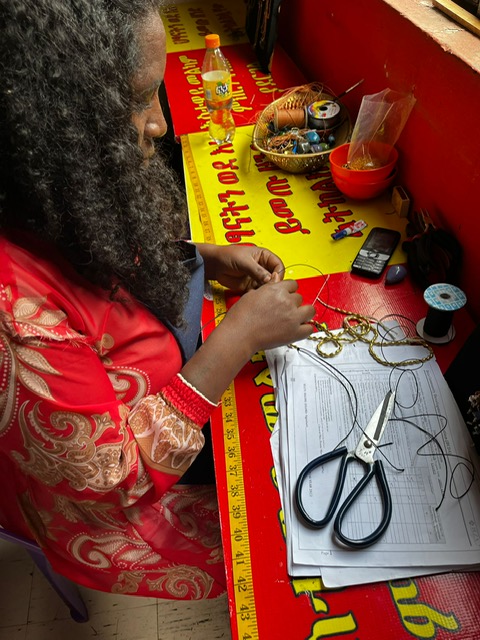
Originally it was started with MCC support and training, to help HIV+ women
turn bullet casings into beads for jewelry and earn a living. Their craftsmanship
is quite amazing. It was a good day for buying gifts for friends!

BCDA visit
Finally we ended up at the Beza Church Entoto Program
Office, which houses their non-formal education program. Program coordinator Lydia
led us through a tour of the facility. They have now revived their own jewelry
making program (they were the originators of the idea) for income generation.
But the main purpose of the center is to provide after-school tutoring to
low-income, vulnerable kids with good academic potential. We divided into groups
and visited different classes. The kids are really bright and we had some very
good interactions with them.

math class
The most impressive key performance indicator to
me was this: in 2022, only 3% of all Grade 12 students in Ethiopia passed the
national exam to go on to University (so few passed because the government took
measures to stop cheating). These are abysmal exam results. But of the Grade 12
students in the BCDA program, ALL 10!!! passed the exam. That really shows the
effectiveness of the program to prepare students academically and also to give
them confidence.
Tuesday, May 30: MKC Prison Ministry visit

Prison ministry visit
We elected to leave town at the crack of dawn (6:30 am)
to shorten the time of our journey to Debre Birhan, northeast of Addis Ababa in
Amhara region. It was a rainy morning, but it is beautiful countryside to pass
through, getting higher into the highlands. We had very interesting
conversation in the car about language, identity, division and unity. Often that
is demonstrated by regional flags – Oromia loves to fly their red, white and
black flag proudly. In Amhara, we just saw the national flag along with the
same colors on the Orthodox churches. By the time we arrived, the sun had
broken through and we felt like we were right up in the clouds at 2,800 m (9300
ft). We had our breakfast in the traditional restaurant of the hotel and a few
group members made a visit to a local Orthodox church nearby, just to
experience more of that aspect of culture.

Inside the women's prison
The North Shewa zone is a very conservative area, with a
deep sense of pride and honor. The dark side of their rich cultural heritage is
a tradition of revenge killing. For a variety of reasons, murder is common.
When one man kills another, the family of the victim is honor bound to avenge
his death and take the life of a member of the offender’s family. This can set off
a cycle of revenge and displacement that ruins the lives of many families. MCC’s
partner, MKC prison ministry has a goal of breaking that cultural cycle and instead
creating a culture of non-violent response to conflict, restorative justice and
peace-seeking. At the heart of their efforts are two regional prisons. Debre Birhan
prison houses 1800 men in minimum security conditions, and most of the inmates
are doing time for murder.
Finally we were able to arrive at the Debre Birhan prison
in the early afternoon. I was delighted to see that our partner MKC had set up
this time to offer training to the members of the village peace committees. About
60 adults (mostly men) were gathered in a large training shed, along with about
12 youth who are school peace club leaders. These peace committees are the ones to
approach the families of murder victims to see if they are open to
reconciliation with the imprisoned offenders. Often they need to visit a family
4 or 5 times before the bereaved are ready to consider forgiveness. Women are
also part of these community structures, but most of them were reluctant to leave
their families to travel away from home for training. 
Peace is as far away as heaven:
Peace committee member Zewdie

Peace club leader Zeyna
We had a chance to talk with several participants in the training.
A young peace club leader, Zeyna Tekula, invited us to come to this home area,
where people from three tribes live. The Afar people have a good traditional
way to resolve conflict and he wanted others to learn from them. Several older
men spoke about their calling to be peace ambassadors. One man, Asseyed
Teshagel, was a victim himself, not of murder, but of the recent war that claimed
the life of his brother and the hand of his son. He said that he was part of
reconciliation because of how important it is that this doesn’t happen again.
In fact his peace committee was part of intervening in a local conflict between
Oromo and Amhara communities. Another older gentleman, Zewdie Desete, mourned
that peace is as far from us as heaven right now. The major challenge is that
we do not listen to one another.
We left the group to continue their training and then went to visit the vocational training facilities in the prison. MKC Prison Ministry has helped to provide sewing machines, wood working and metal working machines; the government sends trainers to help certify inmates in various vocational skills so that they can support themselves when they are released. Other inmates continue (or even start!) their education while in prison. About 600 inmates participate in regular school classes, from Grades 1 through 12, in a school facility that looks like any other school on the outside.

Tigist, Firehiwot & Belaynesh
women staff
We were going to
continue touring the prison, but a pounding rain started and so we took refuge
in a training hall and had a chance to ask many, many questions of the Project
Coordinator, Frehiwot. She did an amazing job of answering all our questions
with stories and illustrations, giving us a better view behind the scenes. The
project is vast with so many different aims, but one of the main aims is to
create a culture of peace in the prison. This includes the work of the two
MKC-supported chaplains, but also a network of inmates who are co-counselors,
trained in listening to their fellow inmates who are dealing with mental and
emotional struggles. We learned that recently the prison was touched by conflict
coming in from the outside, from the national political arena. The Prison
officials called in the MKC chaplain on an emergency basis to help mediate the
sudden tension between the inmates and prison police. Considering that recent security
incident, it’s amazing that we were even allowed to walk into the prison, but
it is a mark of the high regard that the prison officials have for MKC and
their staff and approach.
Wednesday, May 31:
We returned to the prison in the
morning with more cooperative weather and were finally able to enter the women’s
and men’s sections. I was truly delighted to see Inspector Belaynesh again. She
is the prison staff member responsible for the welfare of the female inmates.
She serves much more as a cheerleader and a coach than a warden, and it’s
obvious that she really cares for these unfortunate women. Most of the 36
current inmates are in jail for murder, and most of the murder stems from
response to abuse. Five of the women have little children with them in prison
because there is nowhere safe for them to be outside the prison. The first
woman we met was holding her two year old who had been born in prison. There is
a preschool available on the prison grounds for those children to attend school.
Five other younger inmates actually attend regular classes with the male
inmates. We met three of those girls later in the morning and I was so glad to
see Fasika again – a girl we had met last year. She looked so much more
confident and at ease, and apparently she still manages the little tuck shop
for the women afterschool. She was orphaned young, went to live with her uncle,
and then was raped by him. She is in prison for the murder of the child of that
rape. She’s only 17 now and it is
apparently quite common for minors to be imprisoned along with adults in this
community. 
Inspector Belaynesh

Born in prison
Along with the heart-breaking stories, we were all impressed
at how much the women’s section resembled a village. Women were working along
the periphery of the green space, doing laundry, making coffee, working on
income generating activities, playing with their kids. That’s how it was in the
men’s section too – except that there were many, many more men! Guys were
standing around in small groups, chatting, doing various jobs and just milling
around at a loose end. Some men tend the vegetable gardens. Others run barber
shops to take care of each others’ hair. Quite a lot of men (and women) are employed
by the prison to prepare three meals a day for 1800 people. The injera
production machine of that prison remains incredibly fascinating, and the
prison makes truly delicious bread rolls for breakfast, mixing and kneading the
dough in a bathtub and then baking in a multilayer industrial oven. We stopped
in to visit the Mennonite chapel inside the men’s prison section. It’s truly impressive
that the church leaders are inmates themselves, and run a normal program of
church services, baptisms, etc. Last year, we spent a long time in the men’s
section, visiting lots of different corners of the complex. This year, guards
kept a close eye on us and hustled us through as one compact group. Things are
still tense, and so I’m glad we could visit at all.
Prison bakers
Next we had the amazing opportunity of hearing two
stories of reconciliation, from two men who were just released in January this
year. The first man, Shebeleleh Yekelkel, got into a quarrel with his brother
over land and unintentionally killed him. He spent 7 years in prison. His
younger brother Lema was so hurt and angry over the murder and at first did not
even want to visit his incarcerated older brother. But later on he started to
realize that his parents were dead and he had already lost one brother. The
other brother was still alive and could still be family to him somehow. In the
end, it was Lema who initiated the process of reconciliation.
The second story was even more heartbreaking. Ergete Bansew was a simple farmer with four children, minding his own business, when one day, his brother’s son got into a bar fight over an exchange of words and killed the other man. Ergete heard that the revenge-killers (the dead man’s relatives) were coming for him and so he tried to run out into the forest to hide. Two of his sons refused to let him go and so they fled with him.
Like many
in this community who are part of the revenge-killing culture, he had a licensed
gun with him. As they were hiding, Ergete and his sons heard men approaching. One
son panicked and bolted and many, many shots were fired. It seemed impossible
that his son had survived and the enraged Ergete fired back, not seeing who he
was shooting at. When the dust had settled, the sad facts of the matter
emerged: Ergete’s son had not been wounded. Instead, two men were dead, and
these men were actually unarmed relatives of Ergete, who had come to try to
reconcile the feuding families. Ergete went to prison for 7 years. His nephew
also was imprisoned, but later released in a politically motivated prison break
and ended up in Saudi Arabia. 
Reconciliation stories

Injera in prison
Finally, MKC iniated the process of reconciliation for
Ergete. They went to his home village to assemble a village peace committee and
recruited some of the village elders and religious leaders including Kes Shitaye
Terefe. When they brought the group of elders to meet the offender they were
shocked to learn that Kes Shitaye was actually a victim in this case, brother
to the two murdered men. Not only that, but he had been the local Orthodox pastor
for Ergete when he was young. The prison ministry leaders apologized profusely
for involving Kes Shitaye in the wrong aspect of the case, but it turned out
that he was one who most wanted to be reconciled. It was amazing to see them
sitting side by side, and they continue to all work hard for peace. In fact,
murder rates are actually going down in the community as a whole, a hopeful
sign of culture change.
Apparently, other evangelical churches have tried to
start prison ministries but it hasn’t worked out for them. According to Firehiwot,
this is because God gave the vision to MKC. They are able to raise about $200,000
each year, through offerings at local congregations on a special Sunday once a year.
Even more importantly, they are supported by a powerful prayer ministry, with
people meeting to pray weekly, faithfully, over the past 26 years.
We ended our prison visit by rejoining the training of
village peacemakers. MKC involved us in an awards ceremony, giving appreciation
gifts (shirts and hats) to the peace ambassadors who have had the most fruitful
ministry. They are not paid for this work, so it is good to offer them some
incentive to take it seriously.
After a quick lunch, we hopped in the cars and made the
drive back to Addis Ababa. Driving through countryside is always incredibly beautiful
and refreshing; driving through rush hour traffic back in Addis, not so much.
I need to wrap this up -- it's almost midnight and my mom is arriving tomorrow. This morning, one of our visitors quoted from the peace committee member, who lamented that peace is as far from us as heaven. Yet we pray daily: "Your kingdom come, your will be done, on earth as it is in heaven." Jesus told us that the Kingdom of heaven is within us. Let it be so, through the work of our partners, and through the actions of the community. Let heaven draw near and may the earth feel the kiss of her peace.
Bonus photos:
 |
| At Gulele |
 |
| BCDA jewelry making |
 |
| BCDA WASH |
 |
| Meals together: Wawa, Ron, Rebecca H, Trisha |
 |
| Lake Hawassa |
 |
| Oren and Dr. Ermias BCDA |
 |
| You go girl, in Boricha |
 |
| Gulele walk |
 |
| Peace committee training |
 |
| Inside the women's prison |
 |
| Addis view |
 |
| Shiromeda |
 |
| Breaking bread |
 |
| 3 Rebeccas With Lydia at BCDA, |

 |
| In the classroom |
 |
| Visiting a church |
 |
| Devotionals |
 |
| A joyful home |
 |
| Making bread |
 |
| giving gifts |
 |
| Creating in prison |
 |
| Viewpoint |
 |
| Rebecca, Wonde and Paul above Addis |


.jpg)