Sunday, October 30, 2022

Negotiating post COVID illness, and a Rep. Retreat in Kenya


Illness has been a constant companion to our family, since our return to Ethiopia from the US, though we rarely speak about it in this blog. I will say now that from the day we arrived back, there has rarely been a week in which all four of us were well at the same time. If you add our office staff, it would probably be never. 

Since we have returned, with the relaxing of COVID protocols (COVID prevalence remains extremely low here) and largely abandoning masks, we seem to constantly be contracting and sharing any number of respiratory and gastric viruses. Either David or Oren have missed school days each month since school restarted. And we have all been to the clinic for stool specimens and blood tests multiple times,

Check dams in gulley
I bring this up now because we had an unfortunate conjunction of Rebecca being very ill and bedridden in the past week, while I was out of town showing some back donors work we do with watersheds in a town about 9 hours north of us called Debre Markos. I was gone for three days and during that time Rebecca's condition deteriorated to the point where she went several times to a clinic over 3 days. Without my support at home, the boys stepped up well and got themselves down to the bus and home each day. But we were grateful for friends and neighbors to help with food and making sure the kids had a place to go after school.  I am happy to say, we have a community that is unbelievably supportive.


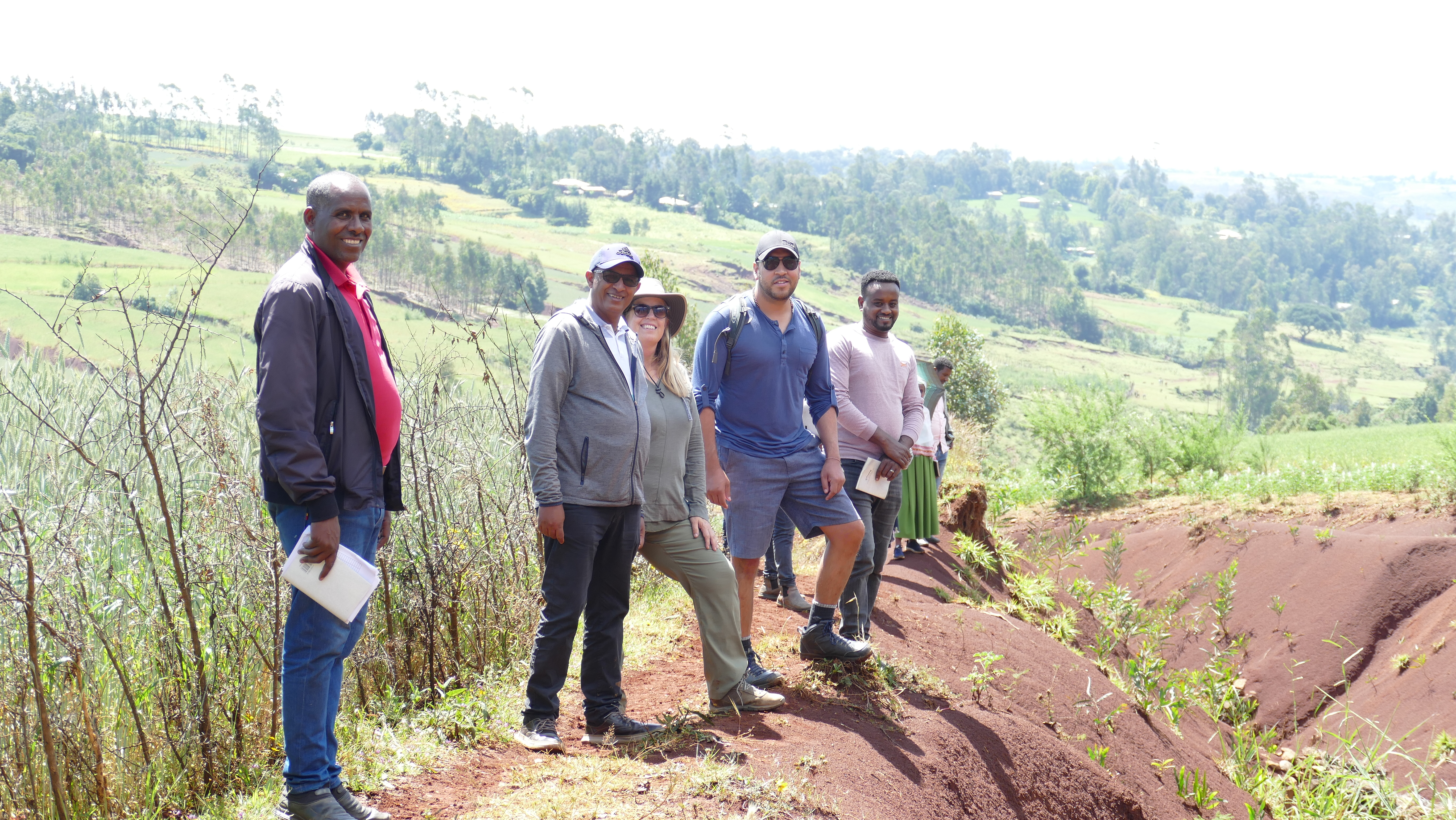
MSCFSO project team and guests
Oren was even sent, one afternoon, on a challenging quest to find a local pharmacy, and purchase doxycycline without a prescription in hand. He succeeded! Needless to say, it was hard to be away from home during this time and I was very glad to be back. During the 9-hour drive home, Rebecca was taken to a clinic once again for evaluation and got home about the same time I did. At that point, her fever was not returning but she was left with a massive migraine. (fortunately, that has abated as well, although Oren and I currently have a stomach virus.)

The purpose of my travel to Debre Markos, as I said, was to host some representatives of an MCC back donor called the Watersheds Foundation. They are an environmental group that supports the work of watershed rehabilitation in multiple countries including one of our projects in Ethiopia near Debre Markos with our partner MSCFSO. 

soil bund
Krista, who serves on the Foundation board, and travel companion Ivan, arrived at the beginning of last week. We have been planning for their visit for several months, and early on Wednesday, Wondeweson our logistics officer and I picked them up from their hotel and took them on the 8-9 hour drive north to Debre Markos where we would meet our partners at their office on the first day. 

The drive cuts through some interesting parts of the country with extensive amber waves of wheat and teff almost ready for harvest, and then a plunge into about 50 kms of the Blue Nile gorge. It feels like a long drive into the bottom of the Grand Canyon and back up. Although it is picturesque, it also very slow as an endless line of trucks bringing gypsum out of the bottom to cement factories at the top, means stop and go driving. The road has also deteriorated from all the trucks drving on it, and at one place, an enormous boulder had slid into the road allowing only one line of traffic to pass at a time. 

Despite delays, we made it in the late afternoon, checked into our hotel and had a late lunch before stopping by the MSCFSO office to meet staff and discuss our agenda for visiting the field. 

Tibteb watershed rehabilitated
I have discussed our support of watershed work in the past, but it bears mentioning again. It is one of the more impressive types of projects we support, as the impact is evident on such an enormous scale. Usually more than 1000 hectares per year. The work involves restoring the health of soil on the large hilly terrain of the Ethiopian highlands, degraded by over 5000 years of farming. Gulleys have become vitual canyons and entire fields are washed away into deep gulches. 

The work of rehabilitation has a number of activities: There is extensive work on stabilizing and reducing the size of gulleys. This includes installing check dams within them to re-catch soil that is washed into them. The gully sides are then planted with indigenous trees and grasses that can prevent futher erosion. Higher on the slopes of the watershed, soil bunds (like terracing) are constructed and planted with forage crops. These forage shrubs planted on bunds serve two purposes-- first to stabilize the soil, but secondly to provide fodder for grazing animals. Farmers are trained to cut the grasses and fodder shrubs to feed cattle outside the watershed area rather than letting them graze freely on crop residue left on the fields (one of the most damaging traditional practices in terms of aggravating erosion.)

As a final step, farmers on the edge of the watershed are trained in livestock management as well as low tillage agriculture methods, and crop rotation to fix nitrogen in the depleted soil. 

It is an impressive sight to see several hundred hectares looking across the watershed with green fields on what was once brown barren land. 

Our guests were quite impressed as they are big supporters of the project.Yihenew the project manager and his staff did a great job explaining the phases of implementation and the various shrubs and crops that are currently being grown. One statistic I remember is them saying they have planted approximately 3 million trees in the Koso Ambo and Tibteb watersheds since they began about 4 years ago. 

Lupine planted for nitrogen fixing
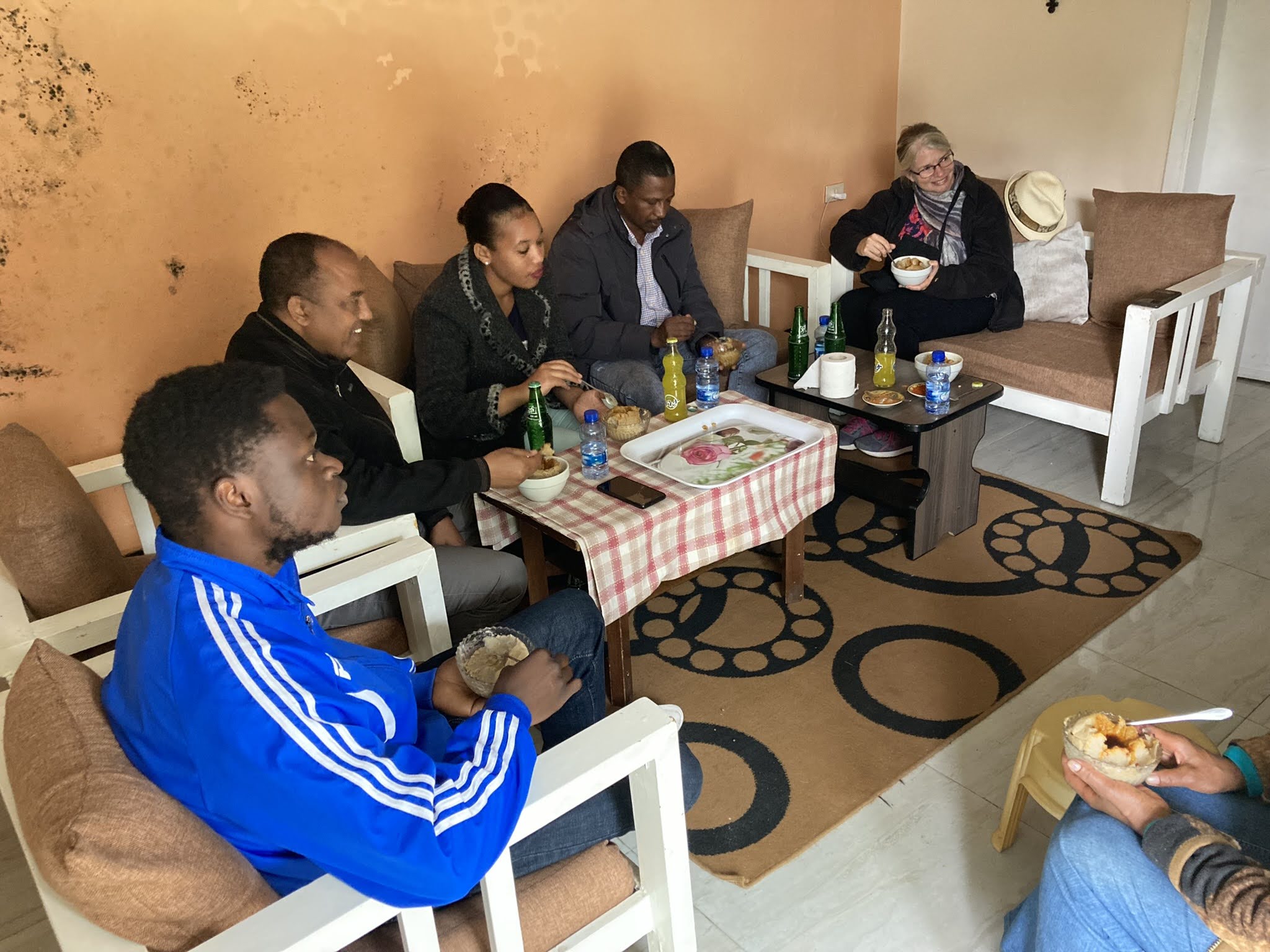
Besides visiting the watershed, we had opportunity to give our guests some cultural experiences, mainly though food, and Wondweson was a very good cultural translator regarding Ethiopian delicacies that Debre Markos is known for. 

I wish I could have been more present, but I was getting daily updates from Rebecca telling me she was getting sicker and had to visit a clinic on both Thursday and Friday. Her symptoms strongly resembled malaria or dengue, yet a variety of blood tests could not give a definitive diagnosis beyond something viral. What really helped though, was the way that our team in Addis, as well as our community came around us. Rebecca and I can be strong together but if one of us is down, we are really hobbled in terms of our MCC work as we need to both parent and work very full time jobs most of the time. 

Talking with field and gender officers
Despite the challenge, we returned to Addis on Friday, another long drive, and Rebecca, who had spent the day at a clinic getting more tests (escorted by our accountant Hana), also was arriving back at the house. We thought things were looking up, but Oren sprained his ankle pretty badly at volleyball practice Friday evening. It was good to be together again Friday evening as a family and we laid low that evening, with Oren icing his foot and went to bed early. 

Saturday looked even better as Rebecca improved, but as fate would have it, Oren and I both came down with a stomach virus which meant Oren spent most of Saturday night vomiting. I think we are all on the mend again today on Sunday evening. Praying for a week where we all go to school and work. It will be tough for Oren though, navigating crutches.


All Africa Reps and families
I need to backtrack now to the week before which was quite out of the ordinary and needs a recounting of its own. Rebecca actually got sick last week on our way back from Kenya. The week prior was our kids' fall break from school, and our Area Directors and HQ leaders had scheduled the first All Africa Reps Meetings for the first time since the COVID pandemic hit. This is usually a once in 5 year gathering, and we were very pleased that our Area Directors, who were hosting, decided to have it at Turtle Bay Beach Resort on the Kenyan coast in Watamu. This is a very cool eco-friendly beach resort which can host a large gathering as well as provide lots of activities when we are not in session (especially for the kids.)

We met our new International Program Co-Director Rebecca for the first time in person. There were Reps from Kenya/Tanzania, Rwanda/Burundi, Burkina Faso, Chad, Nigeria, Zimbabwe, Ethiopia, Zambia, Malawi, Mozambique, Uganda, South Sudan, and DRC, as well as Area Directors for North/East as well as South/Central Africa. From HQ a number of people came, including a special children and youth counsellor who speciallizes in working with third culture kids. She was a great asset who planned activities and counselling for kids while the adults met. 
We had several days of meetings by region as well as several days of meetings as a whole group. It was good to see many old faces, and especially the diversity that has been a focus of MCC come to frution. I remember the meeting 10 years ago was composed almost entirely of people from North America (US and Canada). Now more than half are from the African continent, although MCC usually has people work as Reps in a different cultural context from their passport country. So for instance, the Chad reps are Ugandan, etc. 

We had a great time working and playing together. Among the extra-curricular activities we did included a dhow trip down a large inlet which included a stop where they weighed anchor and we were able to jump and dive off the high poop deck like pirates! It was a lot of fun. 

Oren on the dhow
One of my favorite parts was the square/line dancing that Rebecca and I were asked to lead. This is always a very popular and effective team building activity, and is often new to many people who participate. Kids also love to be part of it as well, so the whole family is involved. I try to find new line dances from around the world so it is not too American. 'Yerusalem' still remains popular in our group even though it is from 2020. We added a few 'figure' based dances (a cotillion where you had a chance to dance with everyone). 

We also had some sports competitions as two teams including volleyball, and some games finding prizes in the sand, water polo, as well as building the tallest sand castle and trying to bury someone in the sand completely. 

Our family stayed two extra days to take advantage of snorkeling which is an activity we love. We went out on our own at low tide a number of times right off the beach in front of the hotel, but on the last Friday we took a boat out and snorkeled for several hours over a coral reef conservation area. It is always great to enjoy the quietness of floating over this exotic world and between us we saw, a sea turtle, octopus, lion fish, moray eels and dozens of other species. I will say though, having come here several times in the past 12 years, that there seems to be evidence of coral dying, probably from global warming. It was not as vivid as I remember it.

Sadly Rebecca was already getting sick when we were snorkeling, and by the time we left for Mombasa to catch our plane on Sunday, she was feeling pretty bad. 

We wanted to leave by Mombasa so we could do some shopping at a good grocery store to bring back stuff before we left. Ethiopia's foreign currency has meant there are virtually no imports in stores, so we stocked up on cheese, lunch meat and chocolate among other things. Kenya has great shopping!

Our flight back was quick, less than 2 hours. It was good to be back and we were happy to see that the kitten had survived a week alone (with our cook and neighbors coming in to feed her). 

We have been in intense work week starting right when we got back as quarterly reports had come in, as well as end of the month activities. Rebecca was already too sick to be in the office and  I worked madly on Monday and Tuesday before departing for Debre Marcos on Wednesday, which is where this blog began. 


We continue to do other activities including church and youth group. David's Birthday passed this weekend although we are planning a small party for next weekend. Among the new activities Rebecca and I have joined a choir that is run by our friend Lori K. and are preparing some songs for Christmas. David is Charlie Brown in A Charlie Brown Christmas at his school, and Oren is busy with college applications. That should catch us up for October. 


Saturday, October 15, 2022

Challenges of Water, WASH, and Wells

Women's self-help group meeting
I am fresh off of a field visit to some partners in a town about 1.5 hours South of Addis. Solomon (our Program Manager) and I were visiting a Maternal and Child Health project run by a church partner as well as a WASH project to improve sanitation in three schools where there has been no water source or functional toilets for several years.

By way of premise, I am reminded of a high school biology class I was in, in which our teacher was explaining the limitations of the electron microscope in trying to understand the function of a cell. He noted that freezing, and slicing a cross-section of a cell to put in the microscope was tantamount to dropping a bomb on the roof of the school then peering into the hole in order to understand how a school functions on a normal day. –While there may be some clues in the wreckage about certain objects’ functions, you would not see how it all works.

That is often my sense of my own presence in the communities where our partners are implementing projects. The idea that a ‘ferengi’ (foreigner) can walk into a community and observe without quickly disrupting every activity and becoming the central focus is absurd.

Because of this, it is clear that field visits are well-scripted events with special group meetings planned, often with people waiting for hours for me to show up. Needless to say, things appear to be functioning at their best.

I am not saying this cynically, it is just a reality here. If I really want to have MCC do a monitoring visit, one of our national staff would go without me.

That said, it is always very satisfying to be able to see the projects running on the ground, and I make it my mission to document in photos and stories, the participants who are involved as beneficiaries as well as implementers.

Solomon and I left Addis Tuesday morning and drove to Ziway. Despite heavy traffic coming out of Addis, we arrived just before lunch and met our Mennonite Church Development partner (MKC-RDA) at their office where we had an extensive debrief with the regional office director and project manager.

We provide funds for providing training for volunteers who run 9 self-help groups made up of pregnant and lactating women. The volunteers help reinforce the practice of attending all pre-natal care visits, going to a facility for delivery, doing post-natal visits, getting childhood vaccinations, etc. They also instruct on the practice of immediate and exclusive breastfeeding and introducing a variety of complementary foods at 6 months.

After lunch, we visited several of these groups who were in session. Generally, they had about 20 women (most with children in attendance), who were receiving training, exchanging experiences with the trainer, and cooking some food together based on promoting a diverse diet. The women were gracious in letting me photograph them, even a number of Muslims in full burkas.

Since the groups also include a self-help component, women save money together which they lend to each other to start small businesses. Many have quite successful businesses and Solomon and I visited several. Some had shops, like a used clothing store or coffee restaurant. Others made enjera at home for sale to people in the town.

Ziway is a small but bustling town with a large industrial flower farm (for export). Many people come for work, but most do not find it there. Young women and girls often end up in the commercial sex business in town. These self-help groups provide a way out of poverty and commercial sex work.

Solomon and I finished the day of visits at about 5pm and retired to our hotel for the night. The next morning we started out early with the project manager of BCDA, another church-based NGO that has been doing WASH projects in the town for a number of years.


We have supported them in doing WASH in 3 schools in the city. The schools lack sufficient toilets and none of them had a functional well or any running water at the school whatsoever. All of them served about 3000 students a day.

I need to do another aside here to reflect critically on a western mindset that I come with. There are many aspects of this that seem to defy common sense. Why, for instance, would the local govt. build schools of this size for primary school students which do not have toilets of some kind integrally built into the building infrastructure? The makeshift pit latrines had a few tin sheets as walls and roof and had 6-8 stalls. (That is one stall for every 500 students) Most had them either for the boys or girls, but not both. They are usually located about 100 or more meters from the school itself so it is a hike. There is also no running water at the school so there is no hygiene or evidence of regular cleaning. The toilets are generally surrounded by open defecation all over the floors and the area surrounding the latrine.

Water, available with a hand-dug well could easily serve a school community with some inputs like a pump and storage tank, but none of this is considered to be a basic necessity in the school and is not part of their operational budget.

That said, it is encouraging to see the dedication BCDA puts into the infrastructure (2 ventilated pit latrines in 3 schools) as well as training teachers, administration, and parent’s committees in maintaining good hygiene.

It is a bit disheartening that despite the addition of 3 new latrines (6 stalls each) two of the three schools still do not have sufficient numbers of stalls for boys. (Girls were prioritized in this phase). I also noticed that even after only 3 months, there were already 2-3 broken spigots on the very nicely constructed hand wash station outside the latrines. It is hard to get good hardware here and spigots break easily.

Despite this, it was good to see that having running water near latrines, even the older ones, meant that they could be cleaned with water, and the evidence of improvement was there in the clean wet floors I saw. (I imagine they cleaned in anticipation of my visit, but hopefully continue to do so regularly.)

Again, when I look with western eyes, it seems to fall short of what I would want to find in a toilet at a school, but compared to what they had a year ago, it is a vast improvement.

We went from visiting schools to visiting a very exciting cottage industry BCDA has set up at their regional office. They have begun manufacturing 'dignity pads' (reusable sanitary napkins) in-house. They had several seamstresses constructing them. These pads are invaluable to girls in school who sometimes must choose to stay at home during their menstrual periods. BCDA provides these reusable pads to girls for free as part of our WASH project. 

Solomon and I returned to Addis on Wednesday afternoon. It is a super busy week with mid-year reports coming in, and we were scrambling to get them done before our departure for a week of Rep. meetings in Kenya, to which we departed on Saturday morning.

Rebecca continues the blog with other activities of the past 10 days…

Oren at breakfast
Our older son Oren is now deep into preparing for his college applications, including taking the SAT again.  He hopes to find a good University in the Baltimore/Washington, D.C. area, so he will be relatively close to extended family. It’s a major life decision for him, obviously, as he tries to discern between two very different directions for his future. He’s strong in Chemistry and could combine that with a teaching certificate, for a very practical degree. On the other hand, his life experiences have given him a keen awareness of all that is going wrong in international relations and politics, environmental and economic issues. He would like to be someone who can make a positive contribution to the world, but that would be a very different kind of degree than chemistry. We are really praying for him to apply to a variety of places and then to pray for clarity as it comes time to make a decision.

We have been really glad that Bingham academy has finally opened up again for school sports and activities. Back in Tanzania, Oren really enjoyed volleyball as a sports elective, and he has been able to join the Varsity Volleyball team at his school now. According to him, he’s not the best, but he has fun, and his team plays well together. Last weekend we got to watch Oren’s team play against another international school, and the energy was super exciting to watch. His four closest guy friends are also on the team and I’m really glad Oren has found some community in his two short years in Addis. 

David's class surprise party
A couple of friends also persuaded our younger son David to try out for the drama club, as they prepare to present “A Charlie Brown Christmas” in a few months. Astonishingly, David was cast as Charlie Brown – I guess he must have that super-depressed-sounding voice 😉. He is working on memorizing his lines, and I’m really glad he is part of this student-run effort. It seems like social gatherings are also opening up for David. He was invited to join in a surprise party for a classmate and was very happy to participate. He is also joining us in a community choir, run by friend Lori K, to prepare a Christmas concert. He wasn’t interested in the sports options this term, but he shoots a lot of baskets when he is at home.

youth group games
Junior high youth discussion, 
We took another turn at hosting the Redeemer Youth group last weekend. This time, we had more structured activities, including a big team-building game and a time for worship music and a reflection.  For the last 45 minutes, the kids just enjoyed hanging out together. I also happened to be preaching the next day, and it had been a busy week with little quiet time to prepare and think.  So it was a bit of a stretch, getting a sermon finished after hanging out with 20 teenagers. But I am learning more and more to trust that God will give strength and inspiration when it is needed. 

Coffee at the church potluck
Overall, I am so encouraged by what is happening in our international church in this season. Over 20 new adults have joined us since August and many of them have kids (lots of those youth group folks). Two weeks ago, our Council chair hosted a potluck at her house and the place was full, with over 70 people, both adults and lots of kids. When we met for the women’s bible study on Wednesday night, only 4 out of 10 women had been part of Redeemer for more than 6 months. And we had 6 different countries represented in that group. The new folks are really ready to share and engage and be part of this community, even in the middle of going through the rough transition to a new country.


Intentional conversation at potluck

Sam, Ephraim, Mesfin & Neil
We have had several visitors in and out of the house. Neil Miller stopped back in for a night at the tail end of his two-week trip visiting farmers. We happened to invite Sam Vander Ende to join our time for lunch on that same day. When Neil showed up with an older agronomist named Ephraim, it turned into an impromptu reunion of old friends involved in farming.  We were delighted to watch these colleagues interact and learned that Ephraim was the same man who grafted and planted the four apple trees in our garden, two MCC Reps generations before us.


Paul, Mesfin, Shimeta from AEID,
with Lori & Migs, VHP
We had other visitors this week, from our MCC partner Afro-Ethiopia Integrated Development (a well-drilling organization) and their partner Village Health Partnerships. We have entered into a three-way initiative to try to improve the health systems in a particular region in South West Ethiopia. Many health centres – even referral hospitals -- have no water whatsoever. Imagine requiring a C-section and the doctor responsible cannot change gloves between surgery, let alone wash his own hands. We heard a story about how VHP was once visiting a clinic with some midwife experts. They observed a delivery that seemed to be going well until the doctor was surprised to find that a second baby was still waiting to come out. The infant was delivered blue and floppy, but thankfully the experts knew how to resuscitate a baby that wasn't breathing. They handed the second baby, living, back over to the clinic staff, relieved and happy, though covered in blood from their efforts. They expected to wash up, and for that purpose were handed a half cup of water. There was absolutely no way to get clean and they had to basically throw away their clothes.  VHP is trying to work on the clinical practice of medicine with training and monitoring staff, but they need water as a basic resource for safe care. AEID is working on drilling the wells, and MCC had raised money for this effort through the Abbotsford, BC “Run for Water” initiative. We had to sit and talk for a while because the ongoing rainy season has made it difficult for the big drill rig to travel to one of the required sites, but we are hopeful that it will become accessible in the dry season.


Wonde's birthday cake
Other fun things – our Logistics officer Wondwesen had a birthday this week, so we gave him his free tray of eggs, flowers and a cake on that day. I also went to visit our accountant Eyerus, as she is still on maternity leave. Her son is now two months old and is quite an observant and cheerful little guy.

We are currently on a plane (the best place for blog writing!) on our way to Mombasa. From there we will drive on to Turtle Bay Beach Club for our 4th visit since 2009. This time, we are gathering together with all other MCC Reps in Africa along with MCC leaders from the US and Canada for five days of meetings. It’s a bit hard to be stuck in a conference room when one is at the beach, but at least our kids will have the opportunity to rest and play in the water. We will probably skip lunch and try to sneak in some snorkelling between meetings. And we have two days planned at the end when we will be able to relax and enjoy the place with our kids. News on all that will come in our next blog…


BONUS PHOTOS 

Volleyball

Agriculture friends' lunch

Trying out the Maresha plow / planter


Friday, September 30, 2022

Traditional Celebrations and a Field Visit in October

RPC Preschool students
Today is my last chance to put up a second post in September. I am committed to doing two updates a month so I am settling in to write. It is a Friday afternoon, about an hour before kids will come home. Normally we would still be working on other days, but Rebecca and I try to take a half-day off on Friday for a number of reasons, one of which is that we often work into the evening on other days in order to have zoom meetings with headquarters in the US and Canada. Friday is also a day we ask all office staff to work at home since the office is on our compound. We like to have a day when there is no one here. (Although there is always at least one guard here at all times.)

The past three weeks have had a number of highlights that I will mention first. We passed through two Ethiopian holidays. Ethiopian New Year is celebrated by everyone widely. Many who are reading know that the Ethiopian calendar differs in several ways from the Gregorian calendar. For one thing, they are 7 years behind us, so we just began the year 2015. Second, they have 13 months in the year (although the final month is only 5 days), and these months do not exactly correspond with Gregorian months. Finally, they celebrate New Year's in September. (Don't get me started on the clock which is also 6 hours different than ours -- but honestly is biblical time.)

Crafts at Mesfin's house
New Year's is a special occasion for children; gifts (or money) are given as well as paper flowers. Our colleague Mesfin invited us to come over to his house for a traditional Ethiopian meal. This usually features 'doro wot,' a kind of chicken curried in berbere and lots of butter. Mesfin has three young daughters, so we brought along some activities to do from Sunday School. We had made origami lilies for our lesson and brought paper to teach them how to make them. Since Mesfin lives close by, we were able to walk over to his house after church, and had an enjoyable and educational meal. His family comes from the South (Sodo / Wolaita) and they shared some wolayitinya music with us on YouTube. His younger daughter loves to do traditional wolaitinya dancing and entertained us with her enthusiastic bouncing to the songs. 

Well-drilling
When we are not celebrating holidays, we have been busy with office work. We have a number of projects in transition or at critical stages. We have been waiting for news of a well that our partner AEID is digging near a referral hospital that has had no water, located in West Omo Zone. It is in a very remote area. We were very happy to get news that they hit an abundant aquifer and have capped the well. Two other well sites have been very difficult to access and at the moment the district govt. has loaned them a bulldozer to try to make the road passable for the drill rig. I had planned to go with some co-sponsors to visit these wells in October, but we have been advised that travel in the area is not secure at the moment. We do hear somewhat regularly of attacks on vehicles and have tightened our security protocols around car travel far from Addis.

Despite the increased security at this time, we have been able to host some visitors in the past two weeks. We were happy to welcome the MCC Representatives from Chad, Samuel and Winfred, along with their Program Officer Jonathan. They arrived midweek last week and I picked them up at the airport and set them up in a guesthouse near our house. The next day they had a chance to have habesha food with our staff, prepared by our very capable cook Yeshi. They enjoyed it and Jonathan noted that in Chad they eat a nearly identical kind of bread as injera, which is made with millet rather than teff and is usually mildly sweet. (Injera has a sourdough taste because it is fermented.) I was surprised because I have not seen a similar kind of pancake starch anywhere in East Africa.

After sharing some details of our program during the afternoon, we took them back to the guesthouse but picked them up early the next morning for a trip about an hour and a half south of Addis to a town called Adama where we have an education project. I have wanted to visit this pre-school in the past year, run by our partner RPC, in a very under-served urban market area where there is a large population of orphans and single-parent children, some of them affected by HIV. 

Our rep counterparts from Chad were on an ongoing experience-building tour of education programs that was going to take them to South Sudan next, but they were very impressed with the way the RPC pre-school was so effectively organized toward child-centered learning. They use a Montessori school approach, with very interactive classrooms. All rooms have open areas for interaction with materials. 

The school materials themselves were probably the most interesting aspect of the visit. Teachers, who have been trained in this approach had developed a huge assortment of their own learning materials out of available items. In an American school, these kinds of teaching aids would be readily available in a classroom, but everything here had to be made from scratch. There were many examples of cleverly constructed game pieces and toys to teach counting, simple math, letters of the alphabet, the days of the week, months, etc. 

I was also surprised to see instruction in 3 languages in preschool! They learn Afaan Oromo (the regional language), Amharic, (the national language), as well as some simple English. The Chad reps, as well as Solomon (my MCCE colleague), and I really appreciated the thoroughness of the visit. We had the chance to talk to the director as well as visit many classrooms with kids. Teachers told us about their work and preparations. It was quite inspiring.

Back in Addis that evening, our guests were interested in buying some traditional Ethiopian clothing. We got help from an expat colleague, who guided us to a nearby clothing market area. Rebecca drove and translated for everyone, since it seemed that none of the vendors spoke English. Everyone gathered back at our house for a final dinner before their departure early the next morning. Johnathan found the chill of Addis nearly unbearable and was glad to warm up next to our fireplace. I was the driver, and did notice that security around the airport and on the roads at night is quite tight at the moment. 

Our office has seemed less populated these days as Mesfin, our Food Security Manager, has been out on a number of field visits related to our large conservation agriculture program. It seemed he was flying all over the country with project sites in both the north and south. 

new grill
Despite the heavy workload, not to mention increasing difficult Amharic lessons with substantial homework, we have had a number of nice social events. We have been able to connect with a number of returning neighbors at the SIM compound about a half-kilometer away. We have made friends with Jason and Liz P., who have been here for the past 10 years in total. They have kids David's age. We also continue to see our neighbors Pete and Katy as well as others. The various gatherings with new friends have given us several opportunities to use the new charcoal grill that we acquired since our return.

youth group
We are seeing growth in our church congregation since our return, with a number of new families joining. In addition, we have started to see a growing youth group emerge. We hosted the first gathering with about 16 kids, which was followed two weeks later by another gathering at another family's house that had about 30. It is great to see our kids building a core group of good friends. This was an answer to prayer because they had really felt isolated in year 1 of our time here. I think they are now not the new kids. 

We bookended the last 3 weeks with another traditional celebration, Meskel. This is an Orthodox celebration that is a national holiday. It celebrates the finding of part of the true cross (from the crucifixion) which is claimed ended up in Ethiopia. The celebration features a tradition of making a large bonfire in various locations. When the bonfire burns down, a cross is revealed in the flames (it is made of metal so does not burn.) People also burn small bonfires in their backyards and usually eat a lot of kitfo (raw beef).

Coffee ceremony
Our bookkeeper Hana invited us to her house. Her parents are Orthodox, and we had a lovely meal featuring quite a lot of kitfo (raw beef) as well as k'ocho (or false banana) which is a kind of fermented flat bread made from a plant. This is a tradition of the Guragay tribe in South (of which her family is a part.) The meal ended with the traditional coffee ceremony, beginning with the roasting of green coffee beans. (This was done by her mother). The traditional variation for them is the addition of butter instead of milk. It is an acquired taste in my opinion, a bit like broth. I tried a cup, but declined a second. (I was told it would make my face shine.)

I will end this blog with a necessary account of a tragedy that has deeply affected us. If you have read past blogs, you are aware that Solomon's daughters were given an opportunity to study in the US, through the generosity of a Goshen-based host family, Peter and Jan. This couple had served with MCC in Tanzania and Ethiopia and then Peter had returned to work at a high school in Goshen, Indiana. Peter and his wife have hosted many students from Africa. Tragically, he was hit by a car in the parking lot of the school where he taught (and the girls were studying). He died of injuries sustained from the accident. It is a terrible loss of such a generous man. It is also a very traumatizing event for the girls who are living at his house and were witnesses to the immediate aftermath of the accident. Please remember Peter Shetler's family in your prayers. https://obituaries.goshennews.com/obituary/peter-shetler-1086324272 


Sunday, September 4, 2022

Update on our Work at the Start of a New School Year

I realize it has been a while since our last update about the end of our home leave a few weeks ago. It is time for another report, although finding time, when you have been away from your office for 8 weeks can be tricky. I am currently lying in bed with a mild fever, so thought I would try to begin to fill in the gap. 

One thing worth mentioning is that it is really cold and wet here. I am getting used to the idea that our Annual home leave takes us from hot Maryland August into a very cold wet Addis. The rainy season here is long and very damp everywhere. Nothing dries. We keep our fireplace lit nightly and usually bring in our wet laundry to hang over dining room chairs at night. Last week we had a gigantic hail storm that left a layer of ice on the ground that looked like a snowstorm. 

This year we came back to a new much less pleasant surprise as well. Because of the heavy rain which led to flooding, the reservoir where our water supply comes from was inundated with sewage, as well as some drowned rats. Our staff had had it cleaned out the day before we arrived 

But this week it happened again. Our 10,000-liter tanks fill once per week with city water; when we looked into the tank yesterday the water was blackish green, and I could actually see tapeworm segments and other parasites with my naked eye floating on the surface. Since I am not feeling well today I am worried that it was too late, even with filtering. Today we broke down and paid to have it emptied and cleaned, again, and filled by a water truck. It was a reminder again, that life here has challenges we are not always prepared for in the US.

back from the 1st day
School started the day after we arrived back, which was a challenge (not great planning on our part). But David and Oren were good sports about starting a new year. I think not feeling like the new kids this year was helpful. 

Rebecca and I have jumped right back into office work and since our accountant Eyerusalem, who was pregnant when we left, had her baby Our newly hired bookkeeper Hana had stepped into the accountant's role for now. Rebecca jumped right into providing her with further training, and we set up some new office protocols around cash box, etc. 

Hana's birthday
We have also been in touch with all partners to let them know we are back and arrange some visits. In the past two weeks, we have hosted several at our office and are making a plan to travel where we can. Because of increased instability at the moment, (for reasons I will not detail here), we are having to weigh the advisability of travel, particularly by road, each week. This is the season of developing new project concepts and proposals, so that also involves quite a bit of administrative work as we advocate for budgets for our program with MCC HQ.

Among the new projects we have going this year, I am particularly impressed by our partner who run a free school for very vulnerable pre-schoolers. They are planning to train and incorporate mothers and guardians into self-help savings groups (SHGs), so they can help send their kids to school with a lunch. In this particular population, many of the mothers are single commercial sex workers who have little opportunity to make an income in other ways. The SHGs are an opportunity to provide food security for their kids as well as earn income in another way. (The partner is called RPC for those who know them.) 

Other projects getting underway for renewal since our return including a project to bring several dozen containers of turkey meat to refugee camps for Sudanese refugees in the South. We also are supporting the drilling of wells at a health center and referral hospital where they do emergency obstetric care without any running water!

Honestly, a lot of our work in these projects is administrative, but there is a sense of purpose and motivation that comes with supporting projects that have such a significant impact on the lives of people here. 

We have been getting updates on our other food security partners. It is kind of exciting that MCC has been at the forefront of promoting low-tillage conservation agriculture in the country and even supports a large training program of govt. extension officers to support it throughout the country. We currently have two partners that are implementing scale-ups of these interventions supported by the Norwegian Govt. (NORAD) as well (hopefully soon) the Canadian Govt. (GAC). It is very satisfying to be able to visit projects where we see how an individual preschooler is given an opportunity for an education, but also see projects where partners are reclaiming 1000-2000 hectares of eroded land and transforming it into fertile farmland again. We have not visited these projects since our return, but get regular updates from our food security programs manager Mesfin, who is frequently with our partners. 

Maresha visit
This past week Mesfin and I went on a field visit to see the production of a technological innovation on a 'maresha' a traditional Ethiopian plow pulled by oxen. This maresha will have a wheel which operates an automatic seeder, allowing a farmer to plant while he rips a furrow at properly spaced intervals for conservation agriculture. The maresha was an innovation developed by our friend Neil Miller in Tanzania who was inventing it while we were living in Arusha together. It has been good to see him drop in from time to time to check on progress of its development. 

Meeting with Dr. Getnet
and APDA staff
We have met recently with a consultant who is helping us advise our Afar partner APDA on developing a fodder production plant as a social enterprise for their organization. Fodder for livestock, particularly goats is vital for the Afari people, especially in the dry season when grasses are scarce. Goat milk is the primary food source among nearly all of these nomadic people; food security for the animals is the only way to ensure the food security of their human caretakers. Trying to produce fodder in a sustainable, semi-commercial way requires consideration of a huge number of inputs, and we have been grateful to be working with an expert on livestock production in the Afar region to advise us. 

math tutoring
Our most recent field visit was this weekend on a Saturday morning to see one of our supplementary education programs for vulnerable youth living on the outskirts of Addis Ababa. Several hundred kids from K-12 participate in after-school programs as well as Saturdays. They come from particularly vulnerable families and would have little chance of academic success without extra help. The Beza Church Development Association BCDA is our partner that provides this service to them. Rebecca and I were able to go together to see students in their classes. Then we were treated to a program of skits and poems, along with some games (like bobbing for candy in a vat of flour.) Some of the younger children told riddles.
a riddle...
While I could catch most of this in Amharic, it was good that Solomon our Programs Manager was there to translate as well. (One 3rd grader told our group a riddle that went like this: "An old woman is on one side of a river and sees a magician on the other side. What must she do or say to the magician to get across?... Answer: She farts, the magician smells it and starts waving his hands to fan away the smell, thus parting the waters, and the old woman walks across."--- It is interesting to see those 3rd graders here have the same sense of humor as 3rd graders in the US!)

There seems to be at least as much going on at our church. We have become very involved in various capacities. A less-than-ideal nexus of people on leave and others stepping down has led to several months where the pastoral team of normally 4, is currently 1 in-country, that being Rebecca. This means a lot of coordinating work as she is responsible to be sure there is a preacher every week, among other responsibilities. She has already preached once since our return, and I preached this week. I am also one of the two main Sunday school teachers and am teaching 5-8th graders. We started last week and we have about 30 kids on the roster for 2 classes. 

Sr high youth
Related to that, Rebecca and I hosted a youth group meeting this weekend to see who was interested. We had about 20 youth and several parents who are willing to help us organize semi-monthly meetings for the group. As we are an all-volunteer church, this takes commitment from a number of people for it to work. 

Shalom, Solomon, Seble, Senper
We have had some exciting news from among our staff. Our program manager Solomon had the opportunity to send his teenage girls to finish high school in the US.  Two weeks ago they went to Kenya for a visa interview, at a considerable cost. We were very sad to hear the girls were denied visas. His wife, a person of great faith, told him that she had a vision of the woman who helped the prophet Elisha who in turn resurrected her son. His wife had a vision that God would 'resurrect' the dream of going to the US even after the denial! She begged Solomon to do one more interview in Ethiopia. Miraculously they got an expedited appointment, and were immediately approved!! So now Shalom and Senper, his daughters are going to the US this week. We had a farewell luncheon for them last week. 

In the same week, while we paid a visit to the home of Eyerusalem (our accountant who just gave birth) and Moses her husband, we were told that Moses just got a job at a refugee resettlement organization in Canada. They felt like this was a huge answer to prayer as Moses is not allowed to work in Ethiopia until they have been married for 2 full years. They have been struggling with him being unemployed. While they will be separated for a time, it is a great opportunity and allows Moses to help support his family. Eyerus has a big family network here so she will continue to have support for her son and herself while he is gone. 

If you have been reading the news, you are aware that there has been ongoing instability because of a breach of the ceasefire agreement between the govt. and TPLF forces. Fighting has renewed along the Tigray, Amhara, and Afar borders. We are praying that the govt. and TPLF will return to the reconciliation process and we will not have a repeat of the extensive invasion of TPLF we experiences last year. We would ask that you keep Ethiopia in your prayers in the coming weeks and months. 

Bonus Photos

Our Team with new MCC shirts we brought back from the US


A new grill we ordered before we left that arrived when we returned!