Saturday, May 14, 2022

Breaking the Cycle of Violence, a field visit with Area Directors

Inspector Belaynesh (center) with 4 inmates
Genzabet, Zinu, Meskerem and Netzanet
Since three weeks have passed since the last blog, let me get right into the highlight of these past two weeks:  the visit of our Area Directors, Wawa and Kristen Chege. They are based in Nairobi, Kenya,
and supervise our program. We meet with them on Zoom monthly, but we were so glad that they could both finally come for an in-person visit to Ethiopia this month. Wawa had last visited in February 2021, the same week we were doing our Rep transition. Now we’ve been on the job more than a year and have a lot to reflect on with them. 
They have four kids under the age of 9, so they needed to be creative with their schedule, with Kristen coming first, Wawa coming for 3 days of overlap, and then staying on as Kristen returned home to be with her kids today.

Primary school for 400 in prison
The big event of the Kristen-only days was a field visit to a town about two hours north of Addis called Debre Berhan. Our partner, MKC Prison Ministry, works in that region (North Shewa) with an ambitious prison ministry project. We left town at dawn to get through city traffic early and arrived in time for breakfast in Debre Berhan, The prison ministry project staff met us there and led us to the prison facility for an overall briefing on the program. In fact, Prison ministry works in 50 out of 135 prisons in the country, providing spiritual care and holistic programs. 

Asalefew Wolde, peacebuilding
coordinator
Every year, the entire church nationwide celebrates a “Prisoners remembrance day” and most of the program are funds are raised in that way. Church members also donate clothing, blankets and other needed items. Fifty-one people serve as full-time chaplains in various prisons, and in fact there is no other Christian denomination which dedicates staff to the care of inmates. Even Orthodox and Muslim clergy visit only occasionally for holidays. We learned that many young children end up in prison with their parents, if there is no extended family willing to take them in. The prison ministry builds Kindergartens for young children if needed or helps to pay for food and police escort for children that need to leave the prison each day to go to regular primary schools.

Chaplain Tigist, a graduate
from MK college
In the two prisons of the project area, MCC supports a restorative justice project. In North Shewa, the traditional Orthodox culture also supports a dark undercurrent of violence, in which murder is common and revenge killing is expected of a victim’s relatives. The MK Prison Ministry works both inside and outside the prisons to try to break this cycle of violence. Chaplains and prison officials look for inmates with a good record of showing a change of heart and good behavior, whose sentence has been reduced. Counselors work with these eligible inmates to help them come to a place of taking responsibility for their crimes and seeking reconciliation. Meanwhile, community leaders from these inmates’ villages are trained as mediators. A team of mediators meet with the family of the victim to see if they can also reach a place of seeking reparation and forgiveness. If an agreement can be reached, an elaborate reconciliation ceremony is held, observed by religious and government officials. See Paul’s blog from last year. The inmates’ sentence can then be reduced by another third. MK Prison ministry also supports vocational training for these inmates so that they have skills to make a living when they are released from prison.


Commander speaking in our briefing
The prison commander and a number of police staff serve alongside the MKC prison chaplains and in this case, they sat through the entire presentation and expressed great respect and appreciation for what the Prison ministry does. In fact, the commander accompanied us throughout the day as we toured the prison to witness the realities of life on the inside and the ways that MK Prison ministry provides extra supports for gaps in government funding.

We started by visiting the women’s section. Forty-one sentenced women live together there, sleeping in one big dorm room, along with about 10 women who are still waiting for a legal decision (who have a separate dorm room). Their yard was not big, but it was grassy in the center. 

Commander Zewgel, Inspector Belaynesh
and Inmate Representative Meskerem
Some women were cooking injera, and others were spinning in the kitchen and meeting room. Some women were doing laundry, while others worked in a tiny hair salon, learning skills from an inmate professional. Nursing mothers had their own tiny room so that a restless baby would not wake everyone. We asked ourselves what kinds of crimes women would commit to end up in prison. We did meet one in prison for trafficking together with a brother-in-law. Others were there for murder and theft. One young teenager minded a tiny shop with soap and biscuits. We learned that she had gone to live with an uncle earlier in her life. When he impregnated her, he insisted that the child be killed when it was born. The 13-year-old was in prison for murdering the infant – we did not learn if the uncle was also held accountable. 

It was not easy to hear these kinds of stories of suffering and sin. On the other hand, these women did have a small community together, in conditions that were better than in some free neighborhoods in Addis. The Police Inspector in charge, a woman named Belaynesh, seemed to deeply love and care for the women in her charge. She admitted freely that she is a beggar, begging all the time for better resources and facilities for the women inmates. She helps them with small loans and raw materials for handicrafts, so that they can keep earning a little pocket money while in prison, to pay their fines or buy necessities.

We went on to visit the men’s side of the prison, where 1700 men live together at any one time. It was a sprawling yard, with 42 dormitory rooms, each accommodating about 40 men. A full primary and secondary school had been built inside the prison, with over 400 adult learners trying to continue their education. Teachers are assigned by the government to teach these unusual students. 

The prison even has an attractive library. Several big workshops accommodate vocational training in woodwork, metalwork, and tailoring. Inmates learn skills and build furniture or make clothing. They are allowed to keep a percentage of the proceeds of their products. The MK prison ministry had helped to supply a number of machines for this vocational training.

We continued our tour and learned more about certain practicalities. For example, how do you feed 1700 inmates 3 meals a day? We visited a large room where huge vats of injera dough were kept, with inmates carrying large buckets in a constant stream. 


In another room, about twenty women were cooking injera on woodfired stoves (on days with electricity, they use electric griddles instead). In another room, we visited the industrial oven (donated by MK Prison Ministry) where cooks bake 1700 bread rolls for each days’ breakfast. The flour and teff are all ground in a mill on the prison grounds. Inmates haul the raw grain and mix teff with sorghum. The inmates also get meat every 15th day, using goats fattened on the scraps of leftover injera.

Several things were quite striking on the men’s side. Men were just milling around, sitting, talking, playing games, drinking coffee, and engaging in handicrafts like weaving and basket-making. There were three visible chapels – Orthodox, Muslim and Protestant – and men could go freely into them. There was very little regulation of movement. 

Door into women's section

We just walked right through a series of open gates to get into the inmates’ area. Prison police were in view, but none had weapons. In fact, the commander explained that the police felt much safer this way. No one could snatch a weapon and attempt to use it on an officer. Yes, there were police stationed in distant guard towers on the perimeter of the prison; they had weapons and would use them if anyone tried to escape. But the police mixing with the inmates seemed to have a very easy relationship with them.

This was like no prison I had ever imagined.  I have visited a corrections facility in New York State, and it was nothing like this – there were at least three or four checkpoints. Everything was highly controlled, there were no easy social interactions, and the corrections officers held a highly antagonistic view towards both inmates and ministry visitors. Men’s bodies were cared for well enough, but they were isolated. In prisons in Burundi, inmates got virtually nothing to survive on. If an inmate did not have relatives to bring food, s/he would die of hunger. In this case, the Ethiopian prisons really do seem to be corrections facilities – places where people can experience a change of heart, rehabilitation, and find a new start in life. They are fed and cared for in an adequate way.

Selam Mengesha, Psychologist (right)
We even visited the office of the government-assigned psychologists. They have an open door to talk with inmates dealing with depression and anxiety. One counselor was a woman and we asked how she deals with being female in an all-male facility. She reported that she is highly respected by the inmates, but also well supported by her colleague, a police counselor. In addition, inmate peer co-counselors are trained by the Prison Ministry and bring troubled inmates to her for care; they work well together.

I was struck, over and over, how well these Protestant Prison chaplains work so well and with such a healthy partnership with Orthodox prison officials. We heard from the top that the prison ministry is changing the culture of the area. In the past, revenge was the key to honor. These Protestants were highly suspect and looked down on by the Orthodox. But now, they have really helped to foster a culture in which reconciliation is valued. But we still need help, said the Commander. We need more work in prevention. We need to change the mindsets of children and youth, so that they don’t grow up to commit murder when they become young adults.

Drama by peace club students
In response to this request, the Prison Ministry has also started efforts at prevention. They have helped to establish peace clubs in 4 schools and this new project will establish 6 more peace clubs. They are going to be producing and broadcasting peace messages on the local radio stations. They will convene small social gatherings – coffee ceremonies – in local communities, play the peace messages on tape recorders, and have discussions about non-violent response to conflict. We really hope that some of these new strategies have an impact on the community as a whole.

Family meeting about coming war in drama

We visited one school where a peace club has been working for several years. In fact, it is just getting back to running this year, after a 2-year hiatus because of the pandemic and the conflict. Unfortunately, the peace club is a new adaptation of an old structure, the “peace and security club.” School officials see their greatest problem being truancy. They have recruited the top 4 students in each class to help them with law enforcement and reporting students who “jump over the wall.” This was not what prison ministry had in mind… So, there will need to be some work to reshape the purpose of the peace clubs to focus more on learning about healthy ways to deal with conflict.

Inmate very proud of his tiny garden

We did meet about 20 student members. Some had written poems about the importance of peace. One small group of students performed a drama, in many ways working through the trauma of what they have lived through in these past 6 months. Back in October and November, the TPLF military started marching south on the main road that passes right through Debre Berhan towards Addis Ababa. Their forces got within 50 km of this town, wreaking destruction in all the towns they passed. These students had lived through about 2 months of fear, wondering if they might be killed or raped, robbed from or forced to flee with nothing. Their schools were closed. Their drama helped them deal with these experiences, but still the message was that it is better to go and fight those attacking, rather than sit and wait to be killed. It’s not the message we wanted to hear, but it is the reality that many young people are perceiving. They very much feel threatened by the instability in the country, the threat of ethnic conflict and they need help to figure out how to be a force for change in their country, rather than passive victims of violence, unemployment and despair.

Reconciled inmate, Kefalegn

We had a chance to talk with a few inmates personally on our visit. What was the experience like for them, living through the encroaching war last year? We knew that two of the project prisons had to be evacuated just ahead of the invading TPLF, and all those inmates were taken to Debre Berhan, so that the prison capacity had to be doubled for a few months. Men were even sleeping outside during those months. We thought it must have been a scary and difficult time for the inmates. But two of them said, “I’ll be honest with you… we were excited for the TPLF to come. Maybe we would finally be released!” One woman talked about packing her bags and paying off her debts to the prison inspector, so that she could be ready to run.

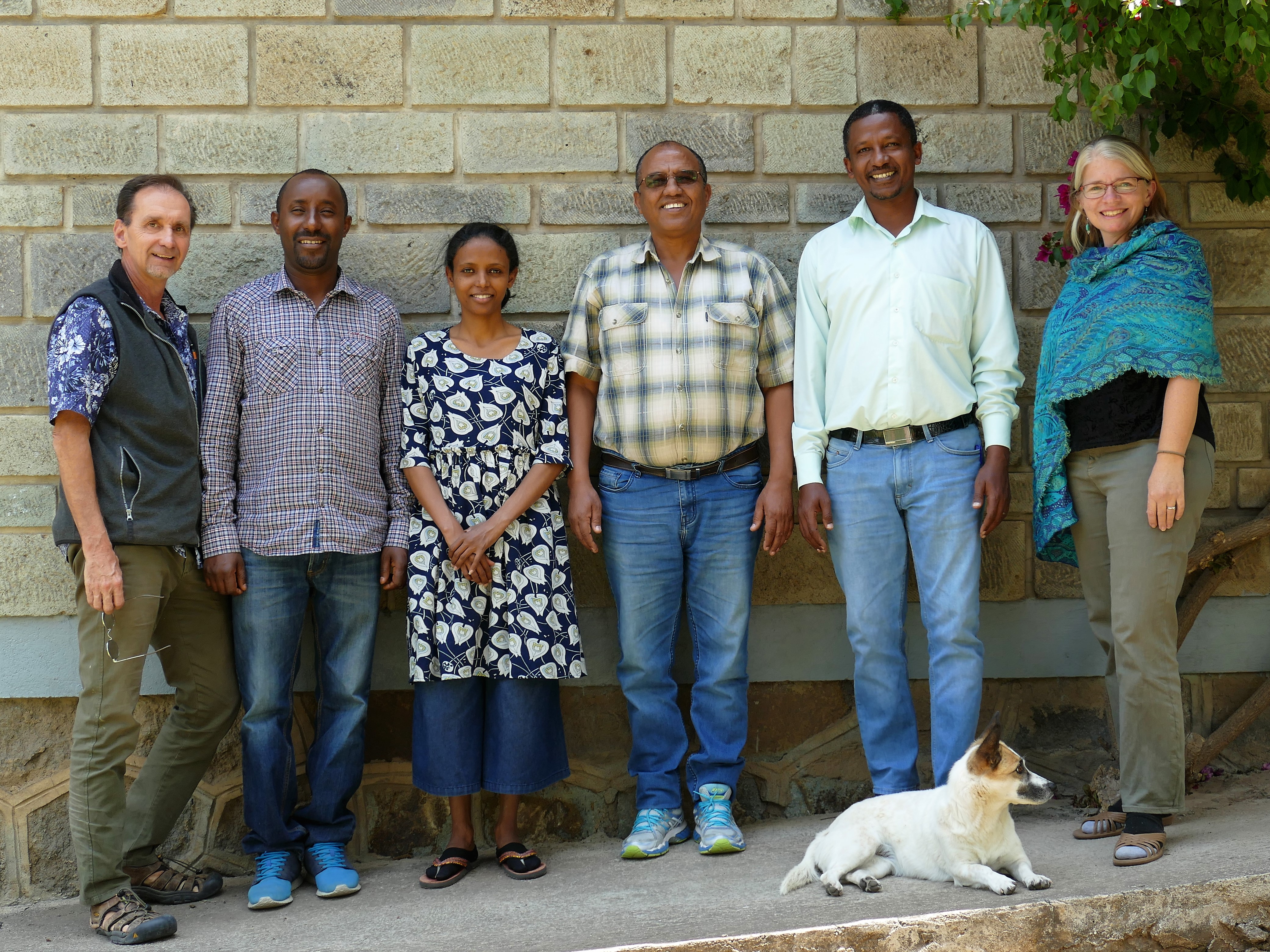
Desalegn, Asalefew, Kristen, Besufekad, 
Wondewesen and Rebecca (Sol took photo)
On our second day of the visit, we were also joined with the President of the Meserete Kristos Church, and so it was very good to have time to process the strengths and challenges of the program. We also had a chance to hear more about what has been going on behind the scenes as Christian leaders are trying to cross over historical barriers in Ethiopia. 

The end of our week with our Area Directors has been spent around the office, discussing our program, them having individual time with each staff member and doing a financial review. Kristen left this morning and Wawa will be here for another field visit with me next week to a watershed management project.

Middle school long jump (David on left)

And now I need to go back and cover a few other things that have been going on at home. The Bingham Field Day was a big event at school right after Orthodox Easter. It had been cancelled for the past two year with COVID, but this year they had revamped the event to take place over three days. It’s an inter-house track and field competition and everyone was required to participate in as many events as they could. The middle school day was Wednesday, and I was glad to be present to cheer on David. It was the first time I had really been on campus for an event and lots of other parents were present and happy to be together again after so many years. I met up with lots of other parents I have gotten to know at church, so it turned out to be a great social event for adults as well. A few restaurant-owning parents set up food stands to supply the crowd. The music was loud and cheerful and mostly from the 80s. David participated in a lot of running races, long jump and hurdles. Overall, it was a great day.

Andy, Oren and Ethan between events

I went back again on Friday to cheer for the high school kids, including Oren. Different parents were present on that day, so I had a chance to catch up with a different set of folks. Paul was not able to attend any of it until the very end of the day because of the NGO report and then visiting donors. I had tried to join the donors for lunch but transport turned out to be impossible that day because of a big Muslim iftar celebration downtown. So, I just decided to be content where I was and enjoy experiencing a little of my kids’ school life.

The next week, starting with Eid, our kids were off from school for their mid-term break. It also happened to be the week that colleagues from Canada were visiting and holding workshops to move forward on some big food security projects. On Monday, Paul, Mesfin and I went downtown early to join the meetings at a big hotel, leaving our teenage kids to fend for themselves. We passed lots of people going downtown as well to celebrate Eid at the stadium. 

David (center) in hurdles

After several inter-religious conflicts in the past week, everyone was on high alert in Addis. I was planning to go back home at lunch time to be with the kids. But halfway through the morning we got news that there had been an incident downtown. Someone had accidently shot off tear gas, sparking a near riot. It seemed much safer to stay put at the meeting and return home when things calmed down. Thankfully we have neighbors who were ready to help our kids if needs be. It ended up being just a very small deal.

We had another public holiday on Thursday, and that seemed like an opportune time to revamp our guest container and get it ready for the visit of the Chege’s. It had become very cluttered with our suitcases and was not arranged in a very hospitable way. With the help of David and our guard Muluneh, we pulled all the junk and furniture out, cleaned everything and arranged stuff in a totally new way. It felt much more spacious and fresher afterwards.

Rearranging the guest container

Oren was not available to help with that project because he had started taking his AS exams that week. In fact, he had one exam a day for almost seven days running. In the Cambridge system, students go on study leave at the end of April and then take these exams between April and June. Each of Oren’s subjects has 2 – 3 different papers. He was studying hard on the days he was home, and then had to take taxis into school to take his exams.  He even took the SATs for the first time at the beginning of May. 


In between things on the holiday week, we hosted a get together for the church youth group. Mostly middle school kids came to our place and played cross net and board games here. A smaller group of older kids played a serious game of Catan.

Oren’s other big end of year project was an oral presentation of his synthesis paper. He had finished his 12-page paper last month – each 11th grade student is required to write a paper that deals with a complex and interesting topic, integrating that research question with a Christian world view. In Oren’s case, he asked the question of whether a Christian could also be a communist. It was interesting to work with him as he studied the communist manifesto side by side with the Bible. There are similarities in some values and goals, but lots of differences as well. Oren did a great job of presenting his conclusions clearly in just five minutes, and then answer the questions of 3 judges.

Oren's synthesis presentation

On Mothers’ Day weekend, I spent Saturday morning preparing a sermon for the next day. So, it was not a restful Sunday morning with breakfast in bed. 😉 Nevertheless, there was a nap in the afternoon, before joining our small group for our weekly bible study meeting. We celebrated in the evening by going out to dinner at a nearby Korean restaurant: my choice! The kids were skeptical at first but have now become fully converted to the flavorful deliciousness of Korean food.

Another bright spot in the past weeks has been the discovery of Friendship park in the center of Addis. We met a visiting friend there for an afternoon before she started her work travel, and it was a great spot to walk around and help her recover from jet lag. 

Becky Stutzman and Paul

The Prime Minister has really supported the development of well-planned green spaces throughout the city and this one is quite inexpensive, while showing off Addis at its best. We admired the fountains and flowers and views and water features as we walked and caught up. Today we went back with the kids and Wawa and discovered even more little corners to walk around and enjoy some fresh air. It’s good to keep finding out the little gems in this city where quality of life requires some effort to develop.


Bonus photos for this three-week period!

Coffee in Debre Berhan with Kristen

Weaver inmate

Early morning dog wake up not working

David's class cheering for senior field day

Oren in the three-legged race with Christopher

Tortoise has a lot of competition for the field

One evenings' entertainment with Daivd

All the stuff that was stuffed into the container!

This week's cute dog picture

David has started taking guitar lessons

Korean dinner for Mother's Day

Solomon, Wonde and Kristen at lunch in Debre Berhan

Women's dorm in prison

Prison library

Team lunch at the MCC office

Oren's 11th grade class at the end of synthesis presentations

Oren, David, Paul and Wawa at Friendship Park

Our family at Friendship Park

Injera dough before it is watered down

Piles of Injera for inmates

Garden inside the prison yard

Metal work shop in prison

Orthodox chapel in Debre Berhan prison

Preaching on mothers' day

Team lunch in our house, with Moses as well

Carpenters Bizwayu and Abebe


Sunday, April 24, 2022

Celebrating two Holy Weeks

We are cruising through April and time for another update. I can't believe it has been more than two weeks since the last one, especially because there was so much happening in March that a weekly entry could barely keep up. With less travel, the overall pace of this month has been considerably slower, despite the fact that the past two weeks have been filled with reporting coming from partners which we must review, respond to, and eventually put into our database. In addition, our annual report to the Govt. of Ethiopia was due at the beginning of the month. With regard to the latter, I spent about two weeks completing the many pages of tables they want regarding our partners and projects. When our logistics officer delivered it where the Charities office informed us that they now had a new format. So I have had to start over from scratch as it is not really similar to the previous one. 

I should come up for air here, but suffice it to say, office life has been incredibly full, even without the addition of field visits. In addition to all of the reports we must process, we are also trying to sell one of our vehicles. (A 1983 corolla) I am amazed at how long people keep cars running around here! The truth is, the import tax on a new vehicle is 3 times the price. So a $ 25,000 vehicle would cost $100,000 here. MCC needs a new pick-up for our field visits but I don't see that in the cards any time soon.

The process for selling a vehicle here is incredibly elaborate requiring many letters to and from the govt. (who set the price) then an open bidding process over several weeks with a sealed chest for offers to be submitted and then opened on a specified day. Potential buyers may look at, but may NOT start or test drive the vehicle. Effectively they must purchase 'as is' without any information on its history. That is how valuable vehicles are here. You buy and then do whatever repairs are necessary.

Along with our office work, we continue to slog along in Amharic language class. We are at a stage where noticeable progress is difficult to see. Grammar is very difficult and some of the initial vocab. begins to fade. But I do feel I can communicate on a basic level to our non-English speaking staff, which is evidence of progress. 

The last two weeks have been Holy Week. This is because the Ethiopian calendar is behind ours with regard to Easter (I might add that they are currently in the year 2014.) Our Holy Week involved a lot of preparation for services Rebecca and I agreed to be responsible for. The big one was Good Friday. 

Planning the service took more time than usual because I had a special event in mind. A number of years ago, I wrote a dramatic reading through 7 meditations based on the last words of Jesus. I have been wanting to use it again. the opportunity to lead the service came when a sheet was circulated to lead upcoming services. 

The service I envisioned was a Tenebrae (service of darkness) with candles being extinguished as the words of Jesus are read. I also had a list of Taizé songs I wanted to have sung between the meditations. Rebecca agreed to lead music and she was able to recruit 2 other musicians (a flutist and trombone player), who supported the cantor parts. 

The service was very moving with Oren, reading the part of John, Pete (our neighbor who is a trained actor) reading the part of James, and Mary was read by our friend Frida. Jesus' words were read by our Zambian friend Moses. We actually did some rehearsals to get it solid. I also built a life-size cross for the front of the sanctuary and put the pews in a box around it. 

The service was very meaningful and attended by over 40 people. Particularly memorable moments occurred when the congregation was invited to put a votive candle at the foot of the cross while singing "Jesus remember me when you come into your kingdom" following Jesus'invitation to the thief on the cross next to him to be with him in paradise. Also, at the end, the lights were all out and Moses walked up to the single candle and blew it out as he said "It is finished", then we sat in a discipline of silence in darkness for several minutes, before the musicians started singing: "Within our darkest night you kindle the fire that never dies away." The evening felt like a sacrifice of creative adoration in preparing it and seeing it come together. 

Easter Saturday was interesting in that a bull arrived at our house. Actually, it was quite dramatic. Our staff usually share a bull (an Ethiopian tradition) for Christmas and Easter. About 10 of us buy a share then the bull is purchased and slaughtered and divided up by a traveling butcher of sorts. 

This bull, however, was quite savage and several of our staff came in with it in a truck looking shaken and one was injured. Apparently right after purchase, the bull escaped in the market, charged and nearly gored one of our guards, then rammed a taxi motorcycle driver, before running away into a nearby field. With the help of some local youth nearby they were able to get it into the truck and to our house where they put it tied in the pen at the bottom of the yard where the chicken coop is. 

I was a bit worried because, by popular request, our house was chosen to host an Easter sunrise service at 6am (because we have a lawn). I was hoping the bull would not freak out and escape and start charging around. It seemed to calm down a bit in the afternoon. 

In the afternoon, our next-door neighbor's kids came by in the afternoon to dye some eggs. Eggs are really not a part of Easter anywhere but the US it seems, but the Brits were happy to participate. 

We got up at 5am, and with the help of early arrivals, set up our lawn for a sunrise service, followed by a breakfast potluck. It was well attended! We had over 70 people, I believe--the weather was perfect, and the bull was quite calm! I was actually surprised to see so many kids at that hour. Breakfast was an impressive international affair with many dishes from all over the world, including Scandanavian devilled eggs with smoked salmon and caviar on them. (Lots of chocolate as well!)

I don't remember much about the rest of the day, except taking a long mid-morning nap. 

The following week was the beginning of Orthodox Holy Week so it felt like we were starting over, albeit we were not involved in any of the events. 

Other highlights of the last two weeks included some activities for the kids: Oren went to a formal dinner dance for the high school. He looked pretty good dressed up and was very happy to be going. It is good to see him fitting in well considering he was one of the new kids at Bingham this year. 

Oren has been very involved in doing mock exams in preparation for his first set of A levels this year. Levels are the British (Cambridge) curriculum and as I look at the syllabus, quite a bit more challenging than what I did in high school. He has really excelled in math, history, and chem this year. 

In the office, the biggest highlight was the successful renewal of both my work permit and our family residence permits. Many have had trouble doing this, but Wonde our logistics officer is really gifted at cutting through the challenges. 

The workweek felt very full of pressing deadlines and meetings. We have been having a lot of calls to headquarters about new projects, and recently launched a large new food security project funded by the Norwegian Govt. It is really helpful to be getting larger grants to enable our partners to do more, but they require a lot more administration on our end as well. 

When Good Friday #2 came around, we did not have any responsibilities for church and the kids had a school holiday, so we went out to Bishoftu where there are cabins for rent near a lake owned by a mission org. called SIM. We were there for our church retreat and it is only an hour from Addis. It was nice to relax there and stand up paddleboard. Some other families were there as well so David had some friends to play with. Oren actually studied a lot of maths.

Rebecca and I decided to take a long swim across the lake so we took turns, one on the paddleboard and the other swimming< swam across, she swam back. The lake is over a kilometer long but very manageable for us as swimmers. It was really nice to take a long open water swim like that. 

One cool thing we found out is if you drive outside the compound where the cabins are after 8:30 pm, you can see many, many hyenas along the side of the road looking for carrion. We tried it, and it was true. Since it was night, we needed our flashlights out while we passed them, but they were there in droves, nearly 100 all told ambling along right next to the road. I have never seen so many hyenas together in one place in my life. It was like a night safari. Photos were hard to do, but here is a photo of one.

We returned early Sunday morning (Orthodox Easter or Fasika), The bull had been slaughtered at around 5am, so when we pulled into our house at 8:30 it was pretty much completely butchered and divided. All of our staff were there to get their share. They were looking forward to Kitfo (raw beef) for Easter celebrations. We put our share in the fridge and freezer, and will probably have enough beef to last us until Christmas. 

Dividing the meat
The dogs were thrilled to be able to scavenge a number of large rib bones. (They looked like Dino the Dinosaur on The Flintstones, carrying huge bones around in their mouths --for those who get the reference!)

Fasika Sunday afternoon, we were invited by our colleague Solomon to his house for a traditional Ethiopian meal with his family. We went there for lunch and brought some games for the kids. He has two daughters that are close in age to David and Oren. They speak excellent English which is helpful since Oren and David do not speak Amharic. 

We had a lovely meal with just about every type of dish one could imagine, but featuring doro wet, a traditional spicy chicken stew, with enjera bread. We had a nice visit, they all wore traditional Easter outfits, and the girls enjoyed learning some games like Dutch Blitz which they are likely to use when they go to the US at some point soon for study. Our family returned home and ended the extended Holy Week period by watching the new Spider-Man movie. (Monday is a school holiday.)


Team photo we took this week


Monday, April 4, 2022

A Flurry of Fiscal Year Finales

I was hoping that 4 posts in March would keep us caught up for at least 2 weeks, but I was mistaken. March is a particularly busy month for our MCC program because the 31st is the end of our fiscal year. As a non-profit, we have to spend certain allocated funds which we cannot rollover. This puts a lot of pressure on us to complete certain activities, like a professional staff retreat, an all partners meeting, and a few smaller home and office projects for which we have some funds. 

The fact that we had to evacuate in December, and were not able to move around the country between October and the end of January had meant that we had delayed a number of these activities and have now had to cram them into the end of the year while things are relatively stable here. (Note: we still need to do some advance intelligence before we travel far out of Addis as there have been pockets of attacks (not by the TPLF), primarily by extremist Oromo separatists that create some anxiety around travel. 

Despite this, we did take several trips out of town for retreats and had people come to Addis to meet us from around the country for our partners' meeting. Here is a brief synopsis of the 5 events that have happened in the past two weeks. 

1) Staff Retreat: Part of keeping up team morale among our office staff, is participating in an annual retreat. We have not had one since we officially took our role last February and were looking forward to having one in November before the war heated up. It was a bit of a squeeze but we did find a weekend when everyone was free and scheduled a two-day trip to Lake Langano, about 3 hours south of Addis in Oromo region. There are a number of resorts along the lake as it is a destination for local tourism, as well as some international tourists as well. We headed out in 3 vehicles on a Friday. We had altogether, our accountant Eyerusalem and her husband Moses, our logistics officer Wondeweson, whose wife, unfortunately, could not travel that weekend so he came alone, our food security officer Mesfin with his two daughters, both younger than David, and Solomon our senior program officer with his wife and two daughters (both in high school). Our whole family came along as well, of course. 

We arrived, in staggered groups in the late afternoon. The Sabana Resort was nice with a main dining area and a number of independent bungalows. It sat on a bluff about 200 feet over the lake, so there was a brief walk down to it. The lake is a bit unusual in that it looks kind of reddish-brown for most of the day. The color is not caused by soil erosion, though, but rather a high amount of minerals shed by the volcanic rock all around it. The beach was very pebbly, so you needed water shoes to walk around, and most of the rock was volcanic, some pieces even floated on top of the water. The temperature and in the first part of the day the water was very still and nice for wading and swimming. The exception to that was sticking one's head underwater, about one foot down the water got cold quickly and eerily became pitch black. The mineral content is so heavy that it completely blocks out the sun, like you are doing deep sea diving. We found it unnerving to swim under the water, and generally kept our heads above. 

I also brought our inflatable stand-up paddleboard and David brought his fishing rods. Everyone enjoyed the paddleboard and other inflatables we brought, particularly Mesfin's girls. David did not have any luck fishing though. I enjoyed taking the paddleboard out quite far in the morning as the water was very calm. The lake was far too big to get anywhere near the middle. There was also a playground by the lake which had some swings and a giant chess board that kept Oren occupied. 

On Saturday morning our team had breakfast together with families, then took an hour to reflect on 'sabbath', and what rest looks like in our lives. We then spent a good part of the rest of the day by the beach swimming and even played some volleyball. In the evening we had dinner together again before bed. 

On Sunday morning, Solomon's wife Seble, preached for us, as she is quite the evangelist. Rebecca and I were happy to learn some Amharic worship songs as well, as we are continuing to try to improve our conversational abilities. We again spent part of the day at the beach. Unfortunately, our family had to leave on Sunday as Oren had 'mock A level' exams all the next week starting on Monday. We drove back with Mesfin and his daughters who also had to be back for school. 

The following week Oren had exams most days, and when he did not, he was home 'studying'. Despite the fact that it looked like there were alot of videogames played during study time, he aced all of his mock A levels (we found out this week).

2) Prophetic Peace Plenary: Rebecca and I spent our days in the office trying to catch up on work and prepare for the events of the week ahead. We did have one interesting in-town field visit to see a small project that MCC had supported. Several weeks ago, we were approached by the head of an Evangelical Church Network about providing some funding as well as a keynote speaker who could bring a peace lens to the Gospel and galvanize evangelical church leaders to be active peacebuilders in their communities. Having worked in a number of post-conflict countries, we do have a lot of contacts, especially in Rwanda and Burundi where we worked with a number of amazing genocide survivors. We recommended a pastor named Celestin Museka, a Rwandese hutu whose family was murdered after the genocide. His journey to forgive the murderers, and even eventually finance the education of the imprisoned children of the perpetrators is a shattering story of divine grace.

The fact that they were able to get Celestin, within a matter of weeks to agree to the invitation and travel from Texas, where he now lives, to Addis, was a miracle in itself. Rebecca and I attended the plenary where he spoke to nearly 2000 evangelical church leaders from around the country. For him, the gospel of reconciliation in Christ requires us to be reconciled to our enemies--at great personal sacrifice. He challenged the leaders here saying how bad ethnic hatred was, even among Christians just prior to the genocide. I was shocked when he said bluntly--"And here, I think, at this moment, you may be worse!". 

He went on to say, "but the difference between Ethiopia and Rwanda is, the genocide has not happened here yet. That means you still have the chance to repent and stop it." He pulled no punches and challenged them, as church leaders, to give ethnic hatred and division no quarter. 

After the powerful testimony, the room was silent. Rebeca and I had a chance to talk with Celestin and the President of the Evangelical Fellowship. It was clear that they were moved by his word. We will see if prophetic voices rise up from the church against the simmering cauldron of ethnic division here. 

3) Church Retreat Weekend: I think we might need a retreat from retreating soon. The fact was, the weekend after our staff retreat, we had a retreat with our church. It also was on a lake, in roughly the same direction, but not quite as far as the one we went to for our staff retreat. The SIM compound on Bishoftu Lake is a place we have come a few times before and is really quite nice. The lake is deep, but the water is clear (although you can't see the bottom.) This is no resort. The bungalows are quite run down and were built to frugal missionary standards even when they were new, 40-50 years ago. Our family shared a pretty tiny room with a public bathroom. But we did enjoy bringing our stand-up paddleboard and fishing equipment again. David had more luck this time, catching over a dozen tilapia. 

We had a nice time with our church community doing sports and hiking by day, then singing, and playing games by night. On Saturday evening, Rebecca and I were asked to lead a set of folk and line dances. We did some favorites of ours including Pata Pata, Yerusalema,  and the Virginia Reel. Everyone participated and it was a great time!! (sorry no photos as I was calling).  We had church by the lake on Sunday morning, then our Annual General Metting in the afternoon. Rebecca is now officially on the pastoral team. 

We returned in the afternoon Sunday, just in time to join our small group. We slept well Sunday night after a very active weekend. 

4) All Partners Meeting: The following week was no less hectic than any of the previous ones. Again, the reason for cramming so much into March is to spend our budget for certain annual activities before the end of the fiscal year. The All Partners Meeting is an annual gathering of our partners for the purpose of capacity building as well as networking. It is usually held over several days at a conference location, where people from out of town can stay overnight. Because of COVID, MCC Ethiopia has not had one in 2 years. It is a blessing that COVID incidence is way down here at the moment. 

The meeting was on a Tuesday and Wednesday with most of our staff presenting something. Rebecca did a longer presentation on 'Safeguarding' (against sexual exploitation), a partner of ours, Food for the Hungry did a presentation on Complaint Mechanism in emergency interventions. It is a challenge to find ways to allow vulnerable people to report back situations where they may be exploited or unjustly treated, especially in an emergency situation, like an IDP camp intervention. 

Solomon, Mesfin, and I presented on the more mundane topic of reporting for MCC, especially updates to our protocols and report templates. It was actually a good time despite having to leave the house at 6:45 am both mornings to get there on time. It always felt like a long, but rewarding day. We had about 24 in attendance on both days, and many reported back how much they appreciated the discussions. 


5) Rebecca Preaching: The last two days of the week, were still filled with frantic administrative work as the fiscal year-end approached before the weekend. Rebecca and I spent all day Thursday and Friday working in the office even though we usually try to take time off for at least half the day on Friday. 

The weekend remained busy with Rebecca preparing a sermon on Saturday morning, then us hosting our next-door neighbors' Birthday in our yard. They are good friends so that was fine and we had a nice evening with two other families. 


Rebecca preached on Sunday and in one person's opinion "Knocked it out of the park." Her message was on Mary anointing Jesus' feet at Bethany, but she did it in the persona of Mary's sister Martha. It was quite clever and creative! Link to audio here.

I need to come up for air at this point. We are hoping April is less eventful than March, but we will see.